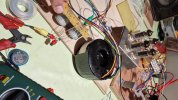
People have forgotten what "audio quality" is

Plenty of people build good speaker systems when they are doing home recording or other electronic music making activities. They usually don't get Hi-Fi gear but studio monitors instead.

Many of them also know that good monitors without room treatment are not very effective. Myself I have studio monitors but I rent, so I don't want to treat the room. Maybe when I have my own house again.

I mainly use headphones.
 
If it's any comfort, I have always listened to music on a legendary set of massive floor speakers with corresponding amps and lossless audio. It's fantastic. You might to change that "no-one" to "one". :)
I like the sound of "legendary massive floor speakers" 😁 IMF's?

In england we had a company called TDL that made some very nice floorstanding transmission line speakers in the '80s, for example:-
View: https://www.youtube.com/shorts/4KHJzOCUC2I

I am a big fan of lowther speakers from manchester, I have an old pair of their mini monitors, sadly their new speakers are a bit ouf of my price range! 😂
 
Plenty of people build good speaker systems when they are doing home recording or other electronic music making activities. They usually don't get Hi-Fi gear but studio monitors instead.

Many of them also know that good monitors without room treatment are not very effective. Myself I have studio monitors but I rent, so I don't want to treat the room. Maybe when I have my own house again.

I mainly use headphones.
Where does one start? At the output or the input? Both are valid.
The output (speakers/headphones) really just "impedence match" to minimize loss at the output, but everything from the input needs to support the output.

And for the record, well designed massive floor speakers are incredible/wonderful/OMG the best thing since sliced bread. If the output media is optimized, then improvements in the upstream chain will be heard.
 
A little off topic of this "off topic" but this has been one of the most interesting threads I've participated in on these forums.
Stuff that mattered to me a long time ago, the science of accurately reproducing "frequencies", all the different ways you can get from source to "ear".
Also off-topic a bit. But have you ever wondered what about music and frequencies that makes the human brain enjoy music?
 
Also off-topic a bit. But have you ever wondered what about music and frequencies that makes the human brain enjoy music?
That is a very interesting area. There is definitely something about valves. I remember hearing led zep playing on an old valve radio in a fish shop once and it sounded incredible. Maybe they mixed it for that kind of gear, either way it sounded much better than on transistors. Just... alive. And there are some interesting effects like harmonizers. Timing in music is also of the essence. Psychoacoustics.

And then we have the phenomenon of 'frisson'.

It's very interesting.

View: https://www.youtube.com/watch?v=MZFFwy5fwYI
 
I admit that audio/music and home theatre are more than a casual hobby to me and that my audio system cost more than some nice small cars (at least new, I bought some components used). It is a 14 channel system (9.1.4) and the main amplifier (there are four mono blocks in addition) does require 240V power (which is very unusual in North America). The system is made in the US and the speakers are made in Canada. I do have a Thorens turntable (TD-126 MK III, IIRC) which I barely ever user. Sure, digital has the loudness wars, but analog records have severe dynamic restrictions, bad stereo separation and high noise. Not even close on a high end system, except for "vinyl nostalgia".

So I am all digital, all lossless. Mostly I am going with CD and DSD (converted to 192kHz/24 bit) audio, all converted to flac audio and stored on my FreeBSD home server. Playback is over HDMI to the audio processor from a FreeBSD HTPC using bit perfect audio (so the computer has nothing to do but get the digital information unaltered to the processor). The same setup also handles passthrough of all surround formats (up to and including DTS:X and TrueHD/Atmos). Everything is OSS only, Pulseaudio is not necessary or beneficial in this context.

Btw, DSD is not inherintly superior to PCM, it all depends on PCM bitrates and sampling.
Very interesting. Out of interest, what audio processor did you use?
 
Me too, I built all kinds of amps, preamps, effects etc over the years, also got involved in bands PA work for a while many years ago. My very first amp was built with ILP audio modules, namely 2-off HY-5 preamps and 2-off HY50 bipolar power amps, back around 1978. These modules were pretty well known in the UK and you could make a nice amplifier with them. Soon after that I started using the hitatchi power mosfets that had just come out, that gave very good results with a relatively simple circuit (and no thermal compensation!). Well.. I've made lots of other stuff, op-amp audio circuts, you know how it goes. I used to build elektor projects too, they had some nice designs. And of course I studied electronics... :-)

Sadly they don't make these ILP modules any more, I think the firm finally folded up a few years ago, but for many years both RS and Farnell used to stock the updated versions of these modules. For a while they had some nice class A mosfet ones, I seem to remember they were called SMOS, I'm not sure whose mosfets they used.

View attachment 24437
That’s great to read — we clearly walked very similar paths 🙂

Those ILP modules were indeed quite popular back then, and for good reason. I remember how accessible and practical that approach was, especially at a time when building something solid and musical didn’t necessarily mean extreme complexity.

The early Hitachi MOSFETs were also a big step forward — simple, stable, and very “forgiving” to work with, yet capable of excellent sound. I went through a similar journey myself: solid-state, op-amps, various projects, repairs, experiments… you know how it goes.

Lately I’ve been enjoying going back to basics again, focusing more on output stages, transformers, and power supplies, and letting the sound speak for itself rather than piling on stages.

Since I had already mentioned this EL84 project earlier in the thread, I felt it was only fair to follow through on that promise and finally share a small glimpse of it. I even took the opportunity to wake up a long-quiet channel, as this exchange felt like the right moment for it to come alive again.

I recently posted a short experimental audio demo of a Class A push-pull EL84 amplifier I’m currently working on — still very much a work in progress, but it gives a good idea of the direction. A more solid technical description of the project is included below the video, so I won’t repeat it here.


Always nice to meet someone who’s been through the same maze of twisty little passages 🙂
 

Attachments

  • 20240811_193753.jpg
    20240811_193753.jpg
    1.6 MB · Views: 11
Just so I don't get stoned in this thread.

“Lossless” digital audio playback is not analog audio playback.
The analog signal still has more information that no A/D converter, no matter how good, can digitize.

The digital signal still has steps that are getting smaller, but are still there. So the digital signal can only approximate the analog signal.

This fact means that “lossless” playback is only a playback of lossy data that approximates the original, but will never actually achieve it.

The only advantage is that the membrane of any speaker, no matter how good or bad, expensive or cheap, is so sluggish that the steps in the digital signal are “compensated” by the “slower” vibration of the driver.

So, that's just a brief summary of my audio engineering knowledge.

By the Way: I use the Focusride Scarlett USB-Audio-Interfaces with FreeBSD. They are really fantastic. :)
 
  • Like
Reactions: mer
Agreed. There is always some loss of information in the in the analog to digital quantisation process. I'm sure I'm guilty of saying "lossless audio" from time to time!
 
Very interesting. Out of interest, what audio processor did you use?
After 25 years with an ancient Yamaha DSP-A1 I tried various Yamaha/Onkyo/Marantz. In the end, I bought an Emotiva XMC-2 and I am extremely satisfied with it.

Note: You hear a lot of libel/negativity about Emotiva products from interested parties, as the brand is "direct to consumer" sales only and thus by default an enemy of the "middle man". Their high-end stuff is made in the USA.
 
Just so I don't get stoned in this thread.

“Lossless” digital audio playback is not analog audio playback.
The analog signal still has more information that no A/D converter, no matter how good, can digitize.
In theory, you are absolutely right. But how does the analog audio get to your system? Mainly, in the form of vinyl.
This means:
  • Heavy dynamic compression at the lathe level to ensure that the groove will not cause skipping of the "needle", there is a significant loss of quality right there.
  • All the steps from analog master tape to the final pressed record, which reduce fidelity
  • Awful stereo separation of less than 40 db at 1000 Hz (less that 15 db at 12 kHz)
  • Wear and tear on any record you play more than once
  • Bad inherent signal to noise ratio, even on good records and systems.
  • Turntable rumble
  • Limited low frequency reproduction (listen to the beginning of Sonnenaufgang, the introduction of "Also sprach Zarathustra" by Richard Strauss vs on Vinyl vs SACD)
After all these issues, what you practically get from vinyl in a home system is much further away from the original analog master than what you get from a lossless¹ digital transport chain. If you are still concerned about A/D/A conversion artifacts, get DSD or high sampling and bit rate PCM that will minimize this.

¹ Lossless as in "no lossy compression", in order to not trigger you. There is no truly lossless audio unless you listen live. Even the best microphone used in recording will already introduce losses, artifacts and bias. It only gets worse from there! :-)
 
  • Like
Reactions: mer
“Lossless” digital audio playback is not analog audio playback.
The analog signal still has more information that no A/D converter, no matter how good, can digitize.
That's simply not true.

First of all you need to understand that every signal, doesn't matter if it's analog or digital, that is somehow processed technically always is bandwidth limited: lower frequencies below a certain limit are cut, as also higher frequencies above a certain limit. No real technical signal contains an infinite bandwidth from 0Hz to infinitive Hz. Impossible. And also useless. Nobody can hear sound at 1Hz or 1 MHz. Pointless to record, process, and store such frequencies. And also analog systems cannot provide all frequencies (Ever listen to some old phonograph? Very analog.)
The question is, where those limits are set. And not seldom when an analog audio signal is digitized the bandwidth is chosen a bit too narrow to reduce the amount of data. But that's not the fault of digital signals per se.
When in the 1980s CDs became popular, their bandwidth was reduced to the frequencies "what average people can hear." People with an extraordinary good sense of pitch can hear the bandwidth is limited comparing to a very good analog sound system playing an extremely good record at highest quality.
But this does not prove digital is always worse than analog. It just proves CDs were not always better than analog recodings (as they were sold.)
Besides the bandwidth you need to see is the sampling rate. As long as the Nyquist–Shannon sampling theorem is fulfilled there is no loss.
So, when you compare an analog with a digital audio signal both having the same bandwidth, and the digital signal's sampling rate is greater-equal two times the highest frequency of the analog signal, there is absolutely no difference at all.
Where you get differences in digital is when you use compression,
so not using any .wav anymore, but some .mp3 for example.
But then we are talking compression, and not digital in general anymore.

And what you also have to distinct is your audio equipment. When you hear a difference between you digital and analog recordings maybe this is caused by your analog stereo equipment is very high quality, while your digital is cheap crap. 😁
Last but not least the digital signal needs to be converted into an analog one and being processed by amps and boxes to be heared.

Those are all factors which can influence the quality of an audio signal, but to say digital is per se worse than analog simply is nonsense.😎
 
Bell Labs paper on nyquist sampling in computer music: "the samples must be converted at an absolutely uniform rate! Variations in sampling rate are [both] audible and objectionable."

us, with our finger on the Nyquist knob on our bit-crusher: what was that? can't quite hear you over how FUCKING AWESOME this sounds
 
Just so I don't get stoned in this thread.

“Lossless” digital audio playback is not analog audio playback.
The analog signal still has more information that no A/D converter, no matter how good, can digitize.

The digital signal still has steps that are getting smaller, but are still there. So the digital signal can only approximate the analog signal.

This fact means that “lossless” playback is only a playback of lossy data that approximates the original, but will never actually achieve it.

The only advantage is that the membrane of any speaker, no matter how good or bad, expensive or cheap, is so sluggish that the steps in the digital signal are “compensated” by the “slower” vibration of the driver.

So, that's just a brief summary of my audio engineering knowledge.

By the Way: I use the Focusride Scarlett USB-Audio-Interfaces with FreeBSD. They are really fantastic. :)
The Nyquist-Shannon sampling theorem states that a sample rate of 2n will be perfectly able to replicate frequencies up to n. All frequencies between 20hz to 20khz can ve fully recreated by a 44khz sampling rate. The 16-bit audio bit depth used in CDs has an SNR of 98db. That means it goes all the way from the softwst sound possible up to sounds that can cause hearing damage, with no (audible) noise. In terms of what a human can hear without suffering ear damage 16/44 is basically the original. Of course this isn't for processing high-frequency analog signals, for which you would of course use analog equipment, but for listening it is more than enough.
 
Bell Labs paper on nyquist sampling in computer music: "the samples must be converted at an absolutely uniform rate! Variations in sampling rate are [both] audible and objectionable."

us, with our finger on the Nyquist knob on our bit-crusher: what was that? can't quite hear you over how FUCKING AWESOME this sounds
Funny, good stuff.

Theorems are absolutely true in the theory world, but may fall short in reality world.

Digital photography vs traditional silver halide. Sampling and number of bits per sample.
Huge difference if bits per sample is 8 (jpg) vs 16.
Silver halide is purely analog, related to amount of light during exposure.
Most often seen in dark tones, which means more bits per sample allow the distinction of very small changes.

Analog circle is smooth.
Approximation of a circle: 16 segments, 32 segments, 512 segments, you get closer each time, but still miss the smallest transitions.

Now you get to the output: as stated earlier in this thread, if you take digital input and play on analog output (speakers) the analog has inherent characteristics that wind up smoothing the digital steps. Fuzzing for lack of a better term.

More bits per sample always gets closer to the original, but it always comes down to "can it be detected".
Is 20Hz to 22kHz truly the full range of frequencies?
Take live Mozart as input, bandpass filter at 20Hz to 22kHz, then sample at 44kHz and you get what the theory says. But is it accurate?
What harmonics and resonant frequencies are there outside that band actually contribute to "your" perception of the music?

The theory has always been an interesting discussion, reality often does not match the theory.

My opinion, I'm not sure anything really matters anymore. You listen to what you like on what you want and if you're happy cool.
 
Back
Top