Cups has security issues. We just don't know them yet.
As far as lpr/lpd is concerned, des@ has not published anything specific, nor can he while most existing FreeBSD installations still run it.
the objective fact is that it is a net negative for everyone involved. even the slopbot companies own research backs this. but everyone who argues that it's good argues from the stance that it makes them, personally, individually, feel more...
Please don't post AI slop.
~//.cache can contain data that, yes, is automatically re-created. But it can be very expensive, for example local LLMs can be stored there and you would have to re-download 100 GB per model. You don't want to do that...
First at all, I know most of computer people are almost greedy for the very most newest version there is, no matter what, but for a beginner, especially the very start I wouldn't recommend to deal with some "still in development and not yet...
First thing you need is a reliable "forever" storage. I use lots of extermal disks and memsticks with my entire system and all programs on it.. It's not massive. 500GB for everything is enough by far.
The maintainance of such personal base is...
First at all, I know most of computer people are almost greedy for the very most newest version there is, no matter what, but for a beginner, especially the very start I wouldn't recommend to deal with some "still in development and not yet...
Please don't post AI slop.
~//.cache can contain data that, yes, is automatically re-created. But it can be very expensive, for example local LLMs can be stored there and you would have to re-download 100 GB per model. You don't want to do that...
First at all, I know most of computer people are almost greedy for the very most newest version there is, no matter what, but for a beginner, especially the very start I wouldn't recommend to deal with some "still in development and not yet...
You could call it a lossy encryption then. My argument in court would be that in face of a lack of creativity the result would by definition be a more or less good copy of the input, thus not a derived work.
I have 16.0-CURRENT notes for a Xfce set-up and volume/laptop brightness keys handled (mixer on key shortcuts, hint to combine internal/3.5mm, acpi load for backlight control)
Don't do either for the reasons you found. Either ask here or use the Handbook. 99% of the people who come here with installation issues didn't use the Handbook and didn't come here to ask questions.
Use the search at the top right of this page...
?
I think many of us have a local snapshot on our machines. No real need for a web link.
Any specific part you recommend combing over? I'm not against the idea. Though I suspect it won't really change Dag's mind because they seem stuck in a rut...
Sure, just boot the USB, at the welcome dialog enter "Live System", mount the file system, edit /<mount_point>/boot/loader.conf.
Assuming menu guided installation:
Example ZFS, for your case:
# mkdir /tmp/zfs
# zpool import -R /tmp/zfs zroot
#...
Try without the "execute" ( "x" , setfacl) access permission on the directory from which the inheritance starts.
I haven't tested it extensively, tested on a regular directory, and ZFS dataset mount point ( .../test in this example), no zfsprops...
My daily OS is windows 10.
Vendors are forcing us all to upgrade to the latest and greatest, if we want to do book keeping, pay our taxes or use a current version of Firefox or ON1 photo editing apps.
My un vetted opinion is they are receiving...
Maybe. Though I doubt anything so vulnerable was found in a disabled by default binary that they need to be discreet. Its more likely they don't have a strong enough rationale to even present to the OpenBSD guys for open discussion.
"Old == Bad"...
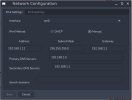
Now understanding what op wants to do (multi-homed server config) I think the "correct" way is with command line and conf files. It has been my experience that network config GUIs are more focused on convenience for single homed DHCP...
No need to add to startup application, it must be inserted in the panel (panel plugin). Click on it to display a menu for enable/disable network card(s) and configure them.
Maybe. Though I doubt anything so vulnerable was found in a disabled by default binary that they need to be discreet. Its more likely they don't have a strong enough rationale to even present to the OpenBSD guys for open discussion.
"Old == Bad"...
Not really. It's just this growing mentality I wish I could get others to see my way that unchanging software does not have to be removed, but I know it's futile. The world is changing around me and at some point, I'll just have to accept, move...
From time to time, one of my responses in the technical part of the forums helps someone solve their problem, and that makes me really really happy. For me, that's the most satisfying thing about this whole forum apparatus.
Maybe. Though I doubt anything so vulnerable was found in a disabled by default binary that they need to be discreet. Its more likely they don't have a strong enough rationale to even present to the OpenBSD guys for open discussion.
"Old == Bad"...
I'm not sure you are facing the same issue. All my setups with emulators/virtualbox-ose-72 use vboxdrv. Booting either UEFI or CSM with no problems. Each runs at least 1 VM in headless mode, but I think this happens later during the boot process.
Thank you very much!
Adding
hw.virtio.pci.transitional="1"
to /boot/loader.conf definitely helped. I'm curious what could cause this. Given the bug mentioned above it seems the reason is still unclear.
This site uses cookies to help personalise content, tailor your experience and to keep you logged in if you register.
By continuing to use this site, you are consenting to our use of cookies.