The LiTe DAC-AH, another NOS DAC; this one has 8 x TDA1543 (Philips) arranged in parallel. The photo shows the thinkpad x220 running FreeBSD 14.4R, with DT-990 PRO headphones, and at the left the DAC-AH LITE is the lower black box, and the silver panel box above it is a mosfet preamp, which drives an HD8-A1 headphone amplifier on a lower shelf, not visible in the photo. Gorgeous sound quality, very natural and musical. The dac itself is driven, via its coax input, by an SMSL PO100, which provides the USB interface to FreeBSD. The dual Burr-Brown PCM56 previously discussed is also excellent in this configuration. So this is another nice system for FreeBSD based audio.
View attachment 26906
The DAC itself is nicely made, having an all steel case, rather than the more usual aluminium. The circuit board is through-hole, this version has an active low-pass filter after the set of 8 TDA1543 dac chips in parallel, based on a pair of analog devices AD847 op-amps. The internal power supply is based on the usual R-core transformer. The two photos below show the internals of the case, and a close-up of the circuit board.
View attachment 26907
Briefly, moving from right to left in the photo above, we have the power supply section at the upper right of the PCB; the digital receiver is between the power supply heatsinks and the rear panel; then the d-to-a converter section, in the central vertical strip of the board, comprising 8xTDA1543 in parallel, and finally on the left an op-amp based active low-pass filter/output buffer, one per channel, together with its associated regulated power supply.
A couple of things I didn't like. The top of the case gets quite warm above the power supply heatsinks, I may drill some holes in the top to allow ventilation. I am also not very impressed with the wiring layout of the power cables, directly above those heatsinks; I would have sited the mains socket on the front of the case, perhaps, or at least well away so that the cables did not lie directly on top of the heatsinks. They have at least fitted an inline fuse to one of the AC lines going to the transformer. I don't really understand why they have sited the mains switch in the centre instead of to one side to save space, placing it in the front centre means the case has had to be lengthened to accommodate the switch, but that is a minor detail; maybe someone liked the way the central power button looks.
I found a circuit diagram on diyaudio, shown below; it can be seen that the 8 dac chips are wired in parallel, so I assume they must be closely matched during manufacture; they appear to have achieved that, as it sounds very good, although I'm only going by what I can hear, without measurements. A requirement to match the dac chips is probably why these units are more expensive. But perhaps 8 chips from the same batch (same wafer?) come out pretty closely matched anyway. Their claimed rationale for using 8 chips in parallel is to improve performance at the high end of the audio frequency range, compared to a single chip. Unlike the PCM56 design, which (I think) uses one dac chip per channel, this design has all 8 dac chips wired in parallel, each outputting both channels, at least, according to the circuit diagram, which I assume is accurate.. Also visible, the LPF op-amps have their own independent regulated split-rail power supply, which is good. The circuit is actually fairly simple, you could replace the 8 parallel TDA1543's with a single one, for example. The digital interface to the coax/spdif sockets is provided by a Cirrus CS8414 digital receiver chip
https://www.alldatasheet.com/datasheet-pdf/pdf/84295/ETC/CS8414.html , which may or may not be fake, either way, it seems to work fine.
View attachment 26909
The TDA1543 is a Philips/NXP dual channel 16-bit dac that can support both NOS and oversampling operation, datasheet is linked below. The unit maker says that in this design the chip is configured in NOS mode. It appears to be a low-cost derivative of the TDA1541, although the block diagrams of the two chips look quite different in some areas, so it's not the same chip.
These two dac chips are capable of good results and have a cult following amongst audio enthusiasts (especially, the TDA1541). The 1541 has considerably better distortion figures than the 1543, see a comparison here
https://www.bramjacobse.nl/wordpress/?p=9600 .
The opamp used in this circuit to build the active low-pass filter and output buffer is an analog devices AD847, which is a high speed buffer op-amp
https://www.analog.com/media/en/technical-documentation/data-sheets/AD847.pdf , which is an 'interesting' choice. The AD847 datasheet shows a circuit for using it as a high speed output buffer for current-output dacs, so perhaps they started from there. The two op-amps on my board have ceramic packages, so perhaps they are genuine, however, the writing on the back of the chips is very faint, although I can make out the AD logo. Well, they sound very nice, anyway.
View attachment 26908
This DAC is quite well known online, it has been quite widely discussed, for example on head-fi.org and diyaudio. There are a couple of links here discussing modifying it to use a passive LP filter, which some people think improves the sound quality.
Hello, I'm looking to do the passive mods on my Lite dac-ah by removing the op-amps from the circuit. Does anyone have the details for these mods? I've read that 2 resistors and 2 caps are needed, but did not find the step by step instructions. Thanks in advance

www.diyaudio.com
Last night the battery of my I2S source ran out so while it was on charge, I unboxed my last remaining Lite DAC-AH to have a listen to that, fed from
www.diyaudio.com
In my version the op-amps are not socketed so I would have to do a little work if I wanted to experiment with these mods. To be honest it sounds pretty nice with the active filter, as they ship it. I believe there is another version of this dac available, which has the op-amps socketed.
Anyway, this is another nice combination, that works well with FreeBSD, it sounds very nice. My main reservation is the wiring layout of the power cables, directly above the power supply heatsinks, but in terms of sound quality, it's very nice.
FWIW, I found another review of this dac, here
https://www.tnt-audio.com/sorgenti/lite_dac_e.html . I think he has reviewed an earlier version, the pcb looks slightly different with red solder mask, and he mentions the op-amps used are burr-brown, not the AD's I have in mine. Otherwise, it looks very similar. The power cables routed over the top of the heatsink didn't seem to worry him, he didn't mention them.
It got another good review here
https://www.highfidelityreview.com/lite-dac-ah.html and there is a head-fi discussion here
https://www.head-fi.org/threads/lite-dac-ah-8x-tda1543-nos.548724/ . It seems that various versions of this design have been around for a while. Lots of people say discarding the output op-amp stage and replacing it with a coupling capacitor is the way to go, so I may try that some time. Then again, I'm sitting here listening to it, and it sounds very nice already.



 Don't think I'm going to attempt anything like that.


 . The consequence is that the audio outputs of the TDA1543 dac chips are driven into clipping on loud passages of music (eg when playing led zep and motorhead), which means you get high levels of audible distortion. To test whether the head-fi posts are correct, I listened to a few tracks from the 'freebsd metalheads' thread, and I can hear the unpleasant distortion, it's there, all right.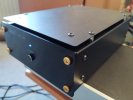
 ). This was pretty cheap, it cost me 25 quid delivered. I ran it from the same high quality linear PSU, and drove it from freebsd through the coax connector, using the SMSL PO100. Sadly it sounds dead and lifeless, to my ears, anyway; my advice would be not to bother. It uses a single TDA1543, and a handful of other components. It does come in a nice little metal case, its well-made, although disappointing that there was no power switch, but you do get a power LED. It just shows that it's not only the particular chip that matters, the circuit used is important too, and its also interesting that several of the same dac chips wired together in parallel sound so much better in the lite dac-ah (assuming this one really does have the same chip, inside the 8-dip package, who knows). The dual PCM56 one is light-years ahead of this in sound quality, imho, and for less money too. So, this one was a bit disappointing, I was hoping it would be better, since it uses the same chip as the dac-ah.