A rant about bying online difference different countries.

Back in the 1980s, when the Chevrolet Corvette was still produced in my town, a co-worker's brother was a big Corvette enthusiast and arranged a tour of the plant and invited me along. It was there we found out that they allowed over 200 defects in the body and paint work on each car to the horror of the brother.
Must have been interesting going around the factory. A guy I worked with had a corvette, he used to drive it into work each day, it looked like a fun motor! Similar stories here, british cars in the 70s were legendary for their poor build quality. It was the Japanese that taught the western auto companies about quality control. I have a little mazda that is my daily driver, its 11 years old now and it has not developed a single significant fault in that time, the only things that have needed changing are brake pads, it's still on the original factory fit silencer. It had a leak in the aircon radiator due to a stone puncture, I think that's the only thing I can point to... and that's most likely due to the poor state of the roads here, they are full of potholes.
 
Must have been interesting going around. Similar stories here, british cars were legendary for their poor build quality. It was the Japanese that taught the western auto companies about quality control.
I remember an episode of top gear where Clarkson took a Corvette around the track and after the first round things started to rattle and fall off.
 
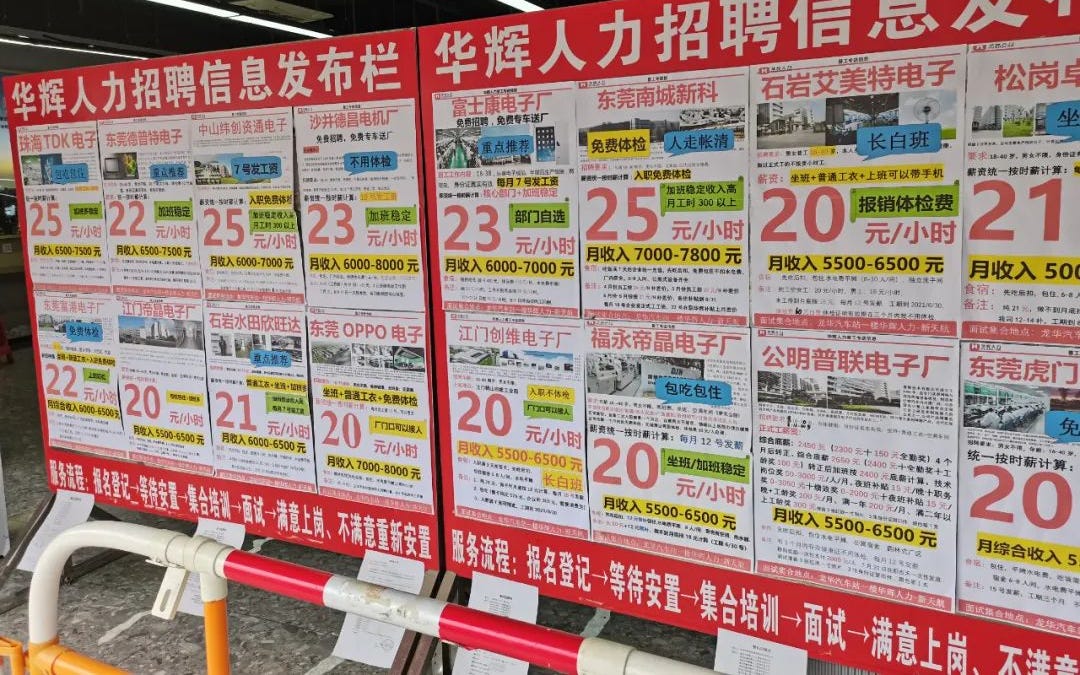
This professor from Beijing University lifted the lid last year on China's industrial gig economy. It's a hard place to be an ordinary worker. I'm somewhat surprised she has been allowed to publish her work, perhaps academics have a little more freedom there now, although I don't think it's anything like the west.

The conditions described sound like a modern version of the industrial revolution in britain, they had all the same hiring practices here, you have a job for the day, turned away if you get there late, piece-work, truck system, all the rest of it. That wasn't so long ago, either. This photo is from 1890, it's only 135 years ago.
1775128059154.png
 
Source? That could invite a serious stomping of your fourth point of contact from Brussels, and that is among the last things the powers that be want to have right now.
NPR (National Public Radio) yesterday. I was in the car listening to the radio. I'll try and find a link.

EDIT: Actually it was The World which is carried on my local NPR station: The World
Findings shared with The World by China Labor Watch (CLW), a US-based nonprofit organization that investigates labor conditions affecting Chinese workers around the globe, reveal brutal conditions within BYD’s Szeged facility. Chinese migrant laborers hired to construct the factory, according to the organization, have consistently faced excessive hours, seven-day work weeks, withheld wages and fear of retaliation. A CLW report reviewed by The World — expected to be released to the public next month — found these practices are “clear indicators of forced labor.”
 
Brussels has been talking about widespread anti-dumping tarrifs on chinese imports, I think they introduced a high tarrif recently on ceramics, with plans to apply tarrifs to other areas. I guess manufactuing in Budapest is to get inside the tarrif wall. But it kind of defeats the whole point if they aren't at least employing local labour, and they should be contracting with EU feeder companies as well for the car components.

If this was the other way round, and it was a western firm going into china (VW say), the chinese would insist on the western company setting up a joint-venture company with a local auto manufacturer, insist on major technology transfer to the chinese firm, teach them everything, in order to gain access to their market. Western firms have no free access to the Chinese market, you can't just go there and start selling your stuff with no tarrifs, unlike what the uk and europe has been allowing. It's no real surprise that they are undercutting our industry as a result.
 
drhowarddrfine Ah, ok. That is the loophole. They have brought the workers to construct the factory, they are not regular factory workers.

For the background: Orban currently on the naughty list of many a state leaders of the EU, and I very much doubt he would risk giving them a legal excuse to tie him up in more proceedings than he currently is. And I doubt in no way what the workers there have to endure.
 
China is starting to build EVs in Budapest.
Yeah. Not only.
Here in Europe we (our news media) are currently panicky about to lose our complete automobile industry to the Chinese. Especially of course in Germany, where cars are the golden calf, and automotive industry is even above the government and the lord himself.
But they have to grin and bear it was their own fault, wrong decisions made by both the automobil industry, and the one politicians exclusively competent in economics.

It was not very long a ago an american billionaire came to germany to bring salvation in form of opening an EVs production plant: produce jobs, bring wealth, and save the world with green cars for everybody. For which all those quixotic, green, socialistic fairies needed to be hushed first, staying in the way of progess with their narrow stone age attitude. Then they suddenly found out, and everybody was shocked, that this guy was not the savior, but a hardball business man, interested in making money. He not only did not produced all the jobs promised and prospected, and the ones created are on bad pay and bad conditions. He also refuses his workers their fundamental rights, like being in an union. But it also turned out, blackmailing is one of his common business practices.

We germans kicked the Chinese out ~fifteen years ago. They tried to bring us green electricity, we decided to refuse that and stay fossil. Now we're moaning we lost that important market, now done by the Chinese selling us the plants, not we producing them here. Well, germans... *sigh* - they don't even see a contradiction between conservative and progress. In contrary, for us it's the same: conservative means good business, and good business is always progress. See, no contradiction.

Personally I'm pretty relaxed about that. Since I passed the 50s. I learned, it's pointless anyway. Open a beer and just watch. All I can do is vote, which I do since I'm 18 at every each single election I'm allowed to vote. It was just only once, a party I voted for got into government. That was 1998. All other elections I 'lost.' But I'm not like many others, electing the winner just to have the feeling to belong to the winners, or stick to one party forever no matter what, and then complain things need to be changed don't change, or even vote some complete BS out stupid contrariness.

To me a car is a tin crate with a propulsion and four wheels, which need to take me reliably and safe from A to B for the least cost possible (which includes fuel consumption), while our suitcases, groceries, and golf clubs must also fit in. Rest doesn't matter.
I'm already in disgrace with several german friends because we drive a french car. For a german that's a no-go, a betrayal. My wife and me don't care about such BS. Our car is in fact dutch, Stellantis. Today brands are just marketing BS anyway. In contrary, the more popular the brand is, the higher its prices are, and the worse its product quality. If you want something really good for a very good price look for a new company trying to get into market.
My most top worries about buying a new car I have at the moment are, there is way too much useless, annoying crap built in, and if you can avoid to buy a thing with a fixed built in battery. Best car I could image was some from the 80s with a 2000's engine built in: steering wheel, speedometer, fuel gauge, four mechanical buttons to press for light, warning light, ventilation, windshield defreezer, a crank for to open windows, a levers and a handwheel to adjust the seat, mirrors adjustes by hand, and an engine that consumes 3l per 100 km, which could easily be done, if we don't had to uselessly carry hundreds of kg of pointless electrical comfort BS crap permanently with us...
Next car will be the one with the least crap, the smallest battery, the least consumption, for the most space. Brand, or country of origin doesn't matter. Most european cars are manufactured in China anyway. Where is the difference? Well, to me the customer, not the stockholders.

Until a year ago I had an eye on a Ford. But then... - well you know.
When it comes to businees the Chinese are always too kind, too friendly, grovelling to customers. I don't really like that. But what I like even less is if own employees are forced to smile all day long, and being punished, if they don't. I don't go to such shops, because it's not how to treat humans. Especially not while their boss constantly clamours, badmouths, threatens and blackmails me and the rest of the world, and gambled away all credit and trust.

Nah, so far I don't see euopeans cars are actually dying, since those are still my first choice anyway.

 
We germans kicked the Chinese out ~fifteen years ago. They tried to bring us green electricity, we decided to refuse that and stay fossil.
Mind you, that was after we first were among the pioneers of green energy and that fell then to the conservatives and the lobbyists. Wind and Solar got "Altmeierd", and the Chinese saw that the things were working and picked up the ball. The same with magnetic trains. We build the test range, the industry kept crying for the gravy train, and now the thing is running in Bejing. Nobody has hurt our industry like the CEOs and their greed.
 
A few thoughts, friends:

1. As far as I understand, the product mentioned by the OP is not actually a hardware part, it seems rather a piece of entertainment media?
In that case the manufacturing cost is near zero, and it is all about the sales strategy of those who own the rights.
Correct me if I'm wrong.

2. blackbird9 "for the last 4 or 5 decades" - that would figure.
Some 30 years ago I heard an urban legend. It goes this way: When the 25th anniversary of the moon landing came near, some US operatives considered to do another flight, to celebrate the anniversary.
Then they figured that it is impossible, because nobody knows anymore how to build the components.
From an engineering perspective I consider this plausible.

3. (this gets longer)
 
It comes to happen that the heritage is not maintained well.

Say, somebody builds up a smb shop of some solid craft, over decades getting successful and well established.
Then the owner dies and the child takes over. They have learned that they have a good running business and are wealthy. So they continue to write bills and watch the desired money come in, but no longer care much about how the business is actually done, i.e. they leave that to the paid employees.
This will not work out.

I think this is what has befallen the western governments as a whole. They have learned that they are world leading industrial countries, and that their only task is to sit on the wealth and make (mostly stupid) laws.
They no longer consider that things need to be maintained, or not even know how to maintain them.

Recently I attended a local convent of the green party. They were quite surprized when I mentioned that I do not have an E-car. No, not an ordinary car either, and no, not even an E-bicycle.
They simply cannot imagine that somebody could not afford these things. They live in a reality tunnel (aka echo chamber) where everybody is (at least) "good situated".
Sure, they have on their charter that they are a "social" party and engage for the poor (and they can get very disgusted when you deny that), but what good is that when they can not even perceive somebody being poor?

How can we expect people to solve the problems when they are unable to perceive them? I do not want to discuss with you what the proper means to solve the problems might be, as this would get a lenghty discussion with certainly diverging opinions. This is about the deeper level of perceiving the problems in the first place.

Sure, in a commercially saturated economy (which we had up to, say 2010) you can induce growth by adding value, even if that is artificial value, like administrative requirements, eco-green labels on food, etc.
As a result, basic food will get twice or thrice as expensive, rents become unaffordable, and everything is wonderful - for those who can still afford them.
The others, those who fall off the shelfs, can then easily be labelled as reactionary, as notorious grumblers, as backwardly, or simply as stupid.

Problem solved.
 
2. blackbird9 "for the last 4 or 5 decades" - that would figure.
To my mind the major change was the thatcher/reagun re-orientation of the western economies (at least, the anglo economies) towards financialisation, which also marked the end of the post-WW2 consensus social contract. In the UK this was called the "big bang" and involved major deregulation of the city of london financial markets, marking a move away from manufacturing and towards an economy based on finance and services. Similar deregulation was carried out on wall-street, which ushered in a phase of de-industrialisation in the west and globalised manufacturing, mainly in China, but also in Japan, Taiwan and South Korea. This led directly to large-scale industrial offshoring and the growth of rust-belts and mass unemployment in the west.
Margaret Thatcher is supposed to have coined the term "managed decline". It is well known that under her leadership a large amount of UK manufacturing industry was closed down at the time.
The next big step along the globalisation road was the admission of china into the WTO, in 2000, as defined by the US-China relations act, which had the effect of normalising and massively accelerating the process of western de-industrialisation.

Looking further back, perhaps the real start of this whole process was the US-China accords reached by Nixon and Mao in the early '70's. Then, following Mao's death, Deng Xiaoping made a decisive change from the Mao era and opened up China to western companies with the introduction of tax-free coastal industrial zones, which over time have become the major industrial centres of China today.

I would say that "managed decline" started as a quasi-official policy with Thatcher/Reagun in the 1980s, with Thatcher herself reputedly coining the term. As far as I can tell, we are still living under this system of international trade today, although perhaps in recent years there have been some moves towards a more protectionist stance in the west, particularly visible in areas like technology; as the strategic consequences have become increasingly apparant, for example at the events in Beijing last year.

Of course, the above is a highly condensed version of real events; there are many other factors that could be considered.
 
China produces the product quality they are contracted to produce.

Here in the US, Walmart is the king of CCS (cheap Chinese shit) built to rock bottom price and quality.

The Chinese can build state of the art optics, microphones, ad nauseum if the price is right.

As for tariffs the EU voted in these taxes, so you get to live with them. Same is happening in the US. Socialism is a very expensive proposition using other people’s money (yours).
 
It will always be possible to get stuff made more cheaply in some third world country with no labour rights, no environmental protection, and import it back into the first world country cheaper than it could be made here, provided there are no import tarrifs to protect the local industry. If it was China 20 years ago, it will be India, Vietnam, Myanmmar or Cambodia today, or perhaps some African countries tomorrow, who knows where they will go next. The end result is a hollowed out economy in the west, with the capability to manufacture just about anything lost for good, and high levels of long-term unemployment, as the people who used to do those manufacturing jobs here are thrown onto the scrap heap. Globalisation has not been without consequences for the west.

View attachment 25786
View attachment 25788

So you get to buy a cheap kettle in wal-mart... but because you lost your well paid manufacturing job to offshoring or foreign competition, that rapidly becomes all that you can afford. So, it all depends on what you want.

Right now, the auto manufacturing industry is busy being destroyed by foreign EV imports. Once it's gone, it will be gone for good, like all the others, with nothing to replace it. You can go and compete with the rest for a job doing burger-flipping on minimum wage instead.
Some things like the US automotive companies deserve to be abolished. Have you actually driven an American made car? They are terrible. Not only are they unreliable, expensive and difficult to fix, and also are based on obsolete technology; Especially EVs, they are about 15 years behind in technology with the rest of the world. That's what decades of protectionism gets you. Insulation from market competition to prop up a monopoly that doesn't deserve to be protected. If you want an American made automobile, buy a Toyota. At least it will be designed by someone who isn't trying to make something with planned obsolescence.

Speaking of, What does the US tech industry do besides sell inferior closed versions of open source projects, with all the competition-preserving features like federation stripped out?

Qbittorrent is available from the ports tree. I suggest using that to get your media fix instead of paying some chain of -corporations- ""rights-holders""" who maybe gives less then 5% to the actual artists responsible for making your media. Send a check to the actual artist by mail. You won't have to fight with DRM that way, or risk losing access to your library any moment and have it spy on you, just so you can watch a TV show.
 
As for tariffs the EU voted in these taxes, so you get to live with them. Same is happening in the US. Socialism is a very expensive proposition using other people’s money (yours).
That only works if you ignore the strategic implications; and the chinese themselves have done extremely well by disregarding that particular advice. The same offshored factories that can be used to make silicon chips, toasters, TV's and EV's can also be used to make stealth bombers, jet fighters, ICBM's, hypersonic missiles and sci-fi laser weapons, and over time you lose your technological, industrial and military lead to other powers. It was technological lead (eg, the manhattan project) and massively ramped-up industrial production, primarily in the US but also in the UK and USSR, that was the decisive factor in winning WW2; the allies out-produced the axis powers by a wide margin, and overwhelmed them.

As for 'socialism', you can either retain your own technology and industrial base... or you can end up near-bankrupting your country by spending 100 billion a year on unemployment "benefits", as the de-industrialised UK is forecast to do by 2030; I can't imagine what that number must be now in the US. Or... you can live like they do in Jo'burg, where you sleep in a safe-room with a gun under your pillow, the house fenced off by razor wire and a guard with a sub machine gun standing in the garden outside your window to keep you safe at night. So it all depends on what kind of life you want to live. I hear that some people in LA are already enjoying living in "gated communities" with private security guards.

Now you can ponder these few photos from Beijing last year, and ask yourself what just changed, in the short time since since 1980. I'm afraid the genie is already well-and-truly out of the bottle, as Elon has also found out with EV's.

1775198222094.png


1775198244891.png


1775198265955.png

1775199887170.png

1775203778948.png
 
Back
Top