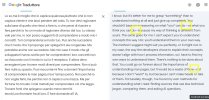
ignorant and arrogant public statements of yours
These are insults. But there is something worse: You dismiss ideas you don't agree with as ignorant and smug, when in fact they are simply ideas you don't share and / or you don't understand yet. That actually makes *you* the smug one. The most effective way to communicate is easy : is to say something like this "I don't agree with your ideas" and explaining why —
not to insult me personally, forcing me to report your comment as an abuse.
Well, I'm not the one who comes to various FreeBSD forums with countless of my new shiny vibe-not-yet-coded
These are your own mental projections. The idea that I want to show off by using AI to act like a know-it-all is just your assumption—and assumptions aren't objective truths. Especially since you don't know me at all. My impression is that your reaction is formulaic; you are reacting negatively to a pattern of behavior that you happen to see reflected in what I write.
projects I obviously would never be able to complete
Merlin the Wizard has come.
So no wonder why nobody takes you seriously. If you can't see it, there is absolutely no point in trying to explain or prove it to you over and over again.
That is a statement that deserves a solid response. I believe this happens because many users developed their skills and absorbed behavioral patterns from the early days of computing—patterns that persist, and they simply continue to follow them. They all share a common root: the myth of the "self-made man"—the myth of the programmer capable of writing massive software projects entirely on their own. I suppose that might have been true years ago—though even then, only to a certain extent. But things grew more complex; the market gradually became saturated with simple projects, giving way to complex ones that required teamwork. Consequently, individual programmers were left with little choice but to work on tiny projects—important ones, certainly, but smaller in scope. Yet, despite these changes, the egos of certain individuals remain—and they need feeding. So, there is immense respect for those who build everything solo, but zero interest in those who accept help and try to make do however they can.
Wake up: times have changed. Those who try to create something to the best of their ability shouldn't be criticized, and those who write significant code shouldn't be overrated. It is also crucial to recognize who the *real* programmers are; after all, while many aspire to the title, not everyone deserve it.
Let's suppose somebody says:
“I need a FreeBSD driver for this undocumented device. I used existing Linux drivers, vendor sources, datasheets, other programmers, and AI models. I designed the experiments, tested every revision on hardware, diagnosed failures, rejected wrong suggestions, and gradually got the device working.”
Calling that person “not a programmer” because they didn't personally type every line would be a very peculiar definition of programming.
Those who don't often vent their frustration on anyone they perceive as wanting to become one... without "sweating blood and tears" for it. That is precisely where the error in judgment lies: Someone who accepts help can work just as hard—and sweat just as much—as anyone else.