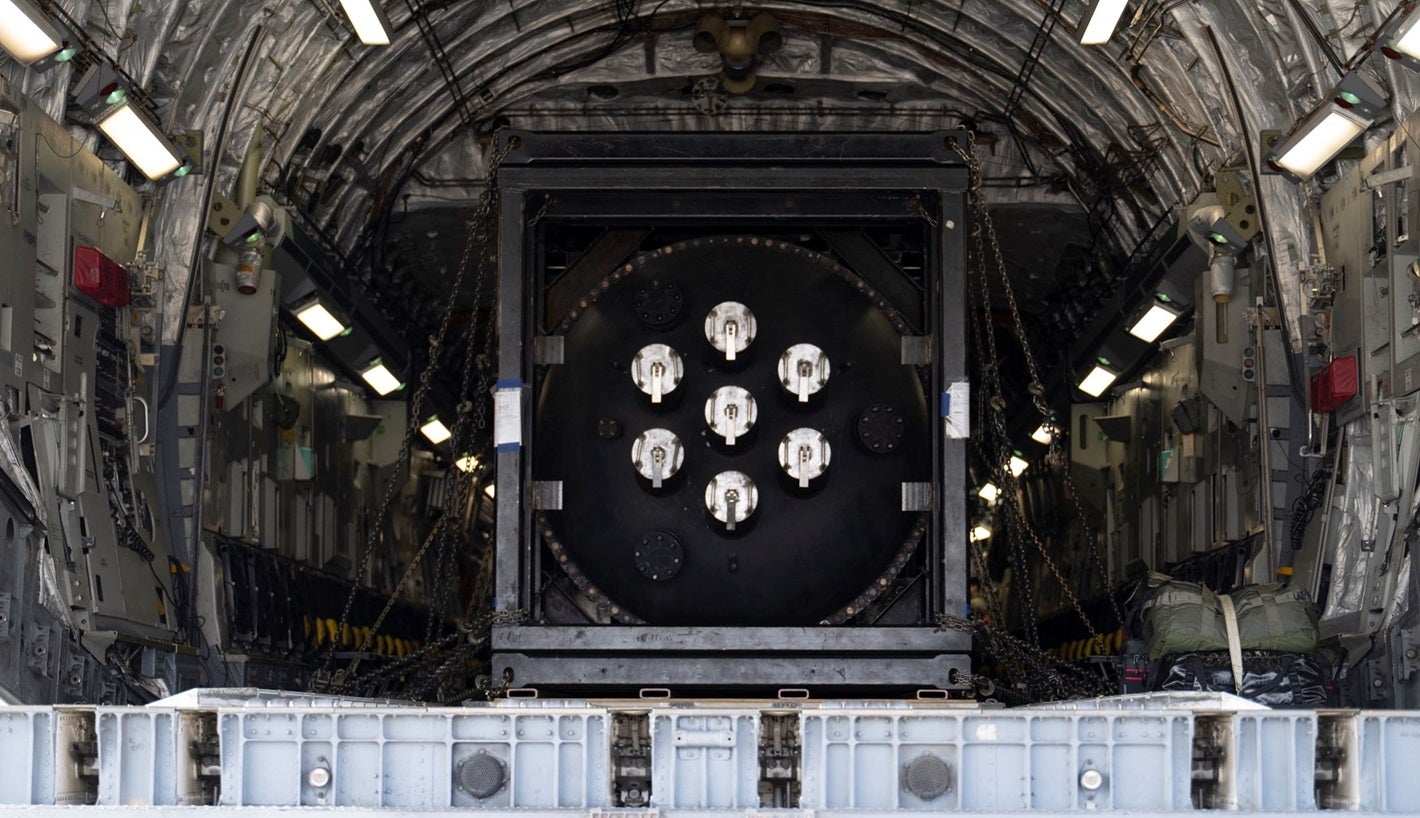
A datacenter in space might be the silliest idea ever proposed.

So if they can figure this out for space then the tech should translate to ground-bound which means every house should wind up with a personal nuke plant that provides power for 100 yrs
Hmm, well, it depends on what the build cost is. Each satellite may still cost, say, half a billion dollars to build. The cost is amortized over its life by 10 billion paid-for interactions with the AI. You make a bet that it won't break or fall apart before you get into profit. It's like putting solar panels on your roof, you don't get into the black until year 7. If they start mass-producing the sats, the cost will come down, but perhaps not to the level where you can put the thing in your garage. Well... maybe they will sell you the kiddie version. Or maybe aliexpress will sell you one.
 
It's just investment bullshit, give us your money or stay behind type of FUD.
second.

How much more should be shooted up there?
We already have more than enough problems with all the trash orbiting our planet already. And if everything is launched what only just Elon dreams of, we don't need to wait for the Perseids anymore to have nice meteor showers. 😁
 
And if everything is launched what only just Elon dreams of, we don't need to wait for the Perseids anymore to have nice meteor showers. 😁
I can tell you're concerned about whether Elon will be able to see the Perseids, and rightly so, but don't worry, he will see them just fine from Mars. He might need to use a telescope. Yes, we wouldn't want him to be disadvantaged.
 
Why a sub though? France does barges with nuclear power for plant maintenance outages. Slip in an extra level onboard for nerd stuff.
 
Space is an extremely hostile environment to everything, you cannot just stack 4nm 3D box of transistor circuity into a satellite.
Isolation cannot be provided without heavy materials, shrinking the payload size.

SpaceX is not going to fail because Starlink.
It is a military snooping and communications network realized by a man that is able to also sell it to civilians worldwide.
It is not even controversial with the adversary - they're trying to build their own and locally jam as mitigation. But nobody is downing Mr. Musks satellites. It is like GPS had an owner from the get go. This is huge.

But, since it is tied to both launch and AI business the prospects of SpaceX as the whole are bleak.
 
I did find it stunning how much The Bear was using UA Starlink accounts and how badly they were affected once they lost those comms.
I would have expected more. But just like Iran slapped around the US, a paper dragon is no fear. We had many planes destroyed on the tarmac.
$500M X-Band radar gone. ect ect ect... But they are not being disclosed to the public. Foreign press pictures versus deepfakes.
The new war is hell. Hard to hide from commercial imagery satellites but now they are "censoring" certain locales. The visual truth hurts.
 
Barge based DataCenter operations seem entirely plausible.


I know Siberia has ships that provide power for shore.

 
My field for the past ten years has been non-terrestrial computers. I design onboard spacecraft systems. Lately I've had some involvement in the LunaNet project (to extend packet data networking to the moon) and a project to specify and build a deep-crater nuclear reactor on the lunar surface to power operations there.

There are "some" valid reason to consider space based datacenters but there are tradeoffs. The single biggest reason its being suggested (that no one is talking about) is security. You cannot violently attack an AI datacenter in orbit. Eventually, as AI gains a stranglehold on the population the earth based datacenters will come under attack. Another "perceived" benefit is immunity to power blackouts.

Datacomm latency isn't much of an issue for LEO stations (low earth orbit) but becomes a huge issue for deep space or lunar datacenters. Traditional TCP/IP is unsuitable for high latency, variable connectivity topologies, and the current work-around is something called DTN (delay tolerant networking) via the bundle protocol.

Right now, the costs and risks extremely outweigh any benefit of orbital datacenters.
 
You could order some actual sunlight with the Amazon APP
That either exists or is in the planning/deployment phases right now. Steerable mirrors in space to deliver sunlight to places that want it. There is already a stationary installation in Norway (on the ground, not in space).
 
You cannot violently attack an AI datacenter in orbit.
Trivial. Launch a small satellite into LEO/MEO which contains a few pounds of ball bearing balls and some explosive. Do so in the orbit of some well-known satellite constallations you don't like. Obviously, it wouldn't go on a NASA or SpaceX rocket, but there are plenty of 3rd world launch services that have less security or are more corrupt.
 
Datacomm latency isn't much of an issue for LEO stations (low earth orbit) ...
It is actually an issue for some specialized applications. Those usually involve satellite-to-satellite communication. For example from a listening or photo satellite to a processing satellite (the "data center") to a disposable weapon satellite (with kinetic or energy weapon). If you want to do these things at sub-ms latency, you're not going to go down to earth and back up.
 
Another problem:Is solar power alone really enough for the demand of a data center considering how power costing they are?
Yes. Solar power is relatively cheap and plentiful in space. I think the efficiency of solar panels is much higher in space (more UV, no atmosphere), and they can be built extremely lightly (thin foils, no wind). Power is a non-issue.

On the other hand, cooling whatever you powered is a HUGE problem. Just like others in this thread have joked about running power cables or fiber optic cables into space, a friend used to joke that big processing satellites would need a garden hose for their cooling water.

The problem is that in space, all cooling has to be via radiation. Radiation is proportional to the fourth power of temperature (Stefan-Boltzman law). That is an extremely steep rise. For example, the sun (at about 5000 K surface temperature) is extremely efficient at radiating heat. But computer chips don't work at 5000 K, they prefer about 350 K. That's over a factor of 10 in temperature, and if you take that to the power 4, your chip in space will just not radiate its heat away efficiently.

So then you build a bigger and less efficient cooler. Or a heat pump that takes the waste heat from the 350 K chip and brings it up to really high temperatures. All doable, but suddenly the weight goes up extremely.
 
What could be the advantage in orbit? I don't think only the high yield of solar panels makes it worth it. Take ground heat. Significant investment and maintainance but unlimited scalable capacity and barely material requirements.
 
Back
Top