Ah, it would started when printer manufacturers start makin printers to be "send me full pixmap images of the page using Windows GDI" or "we accept our proprietary, non-disclosed PDL only, via our proprietary and non-disclosed protocol". In early PDLs, documents could be purchased for LIPS (by CANON) and PostScript (by Adobe), and maybe Prescribe (by KYOCERA), HP-PCL (by HP) and ESC/Page (by Epson), too.It used to be a joke that "the first rule of computing is that printers never work".


T-Aoki Well of course but he said you couldn't do that with Windows PCs and I'm showing that's not true.
So my strategy was to confirm chips supported by {OS/2|FreeBSD|anything non-Windows I want to try} and find common ones, then, looks for the cards that states using the chip. Yes, it IS a kind of gamble.
Were there such things? I don't recall. Gateway made the desktop PC I mentioned for Windows and, as I said, I installed FreeBSD on it without issue. Same for the Dell laptops I have but those are much newer than the Gateway which is from some time way before 2004.That (IS NOT) what I wrote.
What I (DID WRITE) was that you could not do that with a "Windows Only" PC - or a PC that was built with Windows proprietary network and graphic cards where you could only get software drivers for those cards from the vendor and for Windows operating systems only.
Back in the old days, I had an .exe file on my work computer that 'proudly presented my free beverage holder'. Clicking OK opened itAnd there's one thing the modern machine can't do. They've taken away my cup holder!
View attachment 27439

As far as I can recall, almost all ready-made computers sold in Japan unavoidablly pre-installed any of Windows starting from Win95 era, including Gateway. BTO computers sold by some specific shops "sometimes" allow ordering without Windows, but it's not absolutely "ready-made computers".Gateway made the desktop PC I mentioned for Windows and, as I said, I installed FreeBSD on it without issue.

For me the best and only source of information was a friend with modem who was hoarding BBS posts.And I have to mention this classic book by Mr Lewis Eggebrecht (we used to call it the 'eggy bread' book; 'eggy bread' is Yorkshire slang for bread soaked in eggs and fried here). Of course you needed all the datasheets etc but this was the really good book for making PC interface cards. Of course it's all changed now. I think the author was one of the original lead designers of the PC at IBM.

Interfacing to the IBM Personal Computer : Eggebrecht, Lewis C : Free Download, Borrow, and Streaming : Internet Archive
Bibliography: p. 237archive.org
Well, some other essential books were the ibm pc-at technical refernce, the intel 386 instuction set manual, and peter norton's famous programming book...For me the best and only source of information was a friend with modem who was hoarding BBS posts.
TXT manuals on how to make ASM calls in Pascal to draw a pixel. DYI DOOM graphics. etc.
Earlier, I had manual to my Commodore with strange incantations, I later learned was an opcode, but it was in German. So I was stuck at retyping BASIC examples, modifying it and later making my own little programms.
Kids these days can not understand what thirst for information is.
Quite the opposite most likely.
Yes there was lots of other stuff around. Actually that's one thing that's changed.. I hardly ever look at hardcopy books now; everything is online...These books were tad expensive in original and even more expensive translated. In 90s the disparity of income between East and West was still great and these costs were prohibitive.Well, some other essential books were the ibm pc-at technical refernce, the intel 386 instuction set manual, and peter norton's famous programming book...
There was Arachne Web browser but most of the Web was static and not encrypted.Back in the day when we had a 25MHz 68030, we did software development, use LaTeX, play games, have paint programs, video editing, text management, run emulators, run *BSD, ... And everything was a little slower, smaller and simpler. I miss those times. Things like Chrome and Electron would not exist back then, simply because no one would spend weeks to compile them. You would sit down and come up with a more clever idea of doing the same with less resources.
Hitachi sold the FLORA Prius 330J with BeOS R4J and Windows 98 pre-installed.As far as I can recall, almost all ready-made computers sold in Japan unavoidablly pre-installed any of Windows starting from Win95 era, including Gateway.
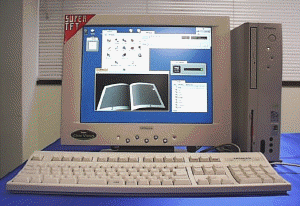
Oh, I couldn't have found it until now! Good exception. But it should've been better another OS for BeOS was OS/2 or at worst WindowsNT.Hitachi sold the FLORA Prius 330J with BeOS R4J and Windows 98 pre-installed.
Good times. In some countries, not everyone was able to own a PC. And even if you owned it, if you were not fluent in dos, that machine was useless waste of money. We had no internet back then either. So it was all hunting disks and praying to god they have no bad sectors. A lot of my childhood was spent learning absolutely everything by myself. Typing a dos command followed by -? and then experimenting with all the command line switches was endless adventure for me. It helped me understand how everything works. It was both simple and very complex and i loved it very much. And then came internet and windows, and golden age of computing came to an end. Everything is shit today and everyone sucks.Back in the day when we had a 25MHz 68030, we did software development, use LaTeX, play games, have paint programs, video editing, text management, run emulators, run *BSD, ... And everything was a little slower, smaller and simpler. I miss those times. Things like Chrome and Electron would not exist back then, simply because no one would spend weeks to compile them. You would sit down and come up with a more clever idea of doing the same with less resources.
You can continue to use DOS, it will work until 2099. You just have to run it on a PC without EFI boot only. I own two 14 year old motherboards which works well under DOS. One with an Intel G2020 and another with an AMD Athlon II X2 270.Good times. In some countries, not everyone was able to own a PC. And even if you owned it, if you were not fluent in dos, that machine was useless waste of money. We had no internet back then either. So it was all hunting disks and praying to god they have no bad sectors. A lot of my childhood was spent learning absolutely everything by myself. Typing a dos command followed by -? and then experimenting with all the command line switches was endless adventure for me. It helped me understand how everything works. It was both simple and very complex and i loved it very much. And then came internet and windows, and golden age of computing came to an end. Everything is shit today and everyone sucks.
You are missing my point completely. Which brings us to what i said earlier.You can continue to use DOS...
... Everything is shit today and everyone sucks.
Now you are going to be crucified by the "experts" on why you should never EVER use anything other than uefi. And they are going to school you on how you are actually using uefi, but you are just emulating legacy bios mode through csm.I avoid using UEFI on machines that have it because I have no need for it at all.
I forgot how much I used scanners and printers in the past: photos, CAD draws, documents, diplomas/certificates. What you produced on a PC didn't exist unless you printed it; today, if you do not publish it online, it is lost.It used to be a joke that "the first rule of computing is that printers never work". They do seem to mostly work now, surprisingly enough.



