
bhyve We have booted Debian with qemu accelerated with bhyve/vmm for the first time. This is an epic milestone for the community.

Hello to everyone.

After a 2 days of full work,we have booted Debian with qemu accelerated with bhyve/vmm for the first time. This is an epic milestone.

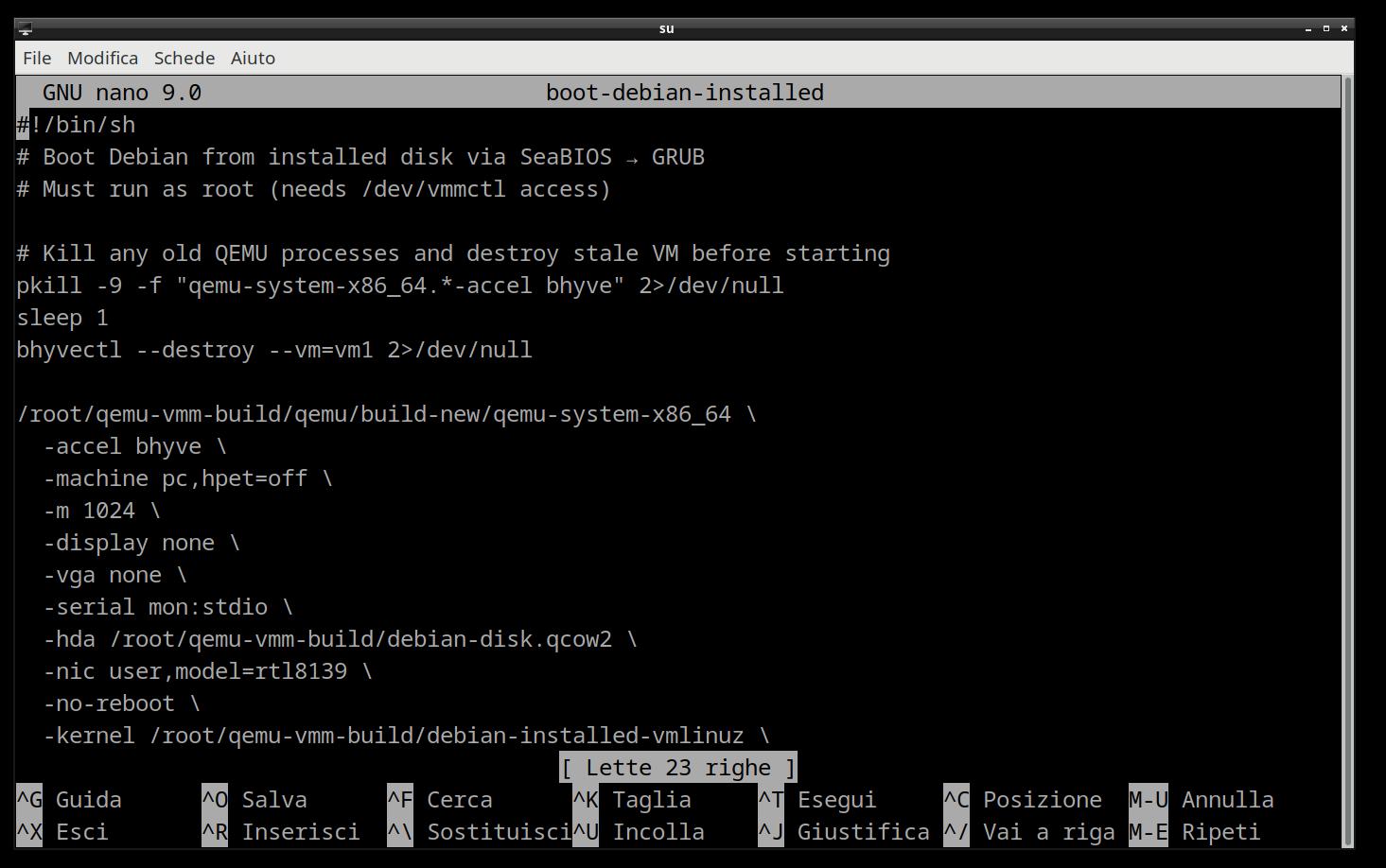
Istantanea_2026-05-17_21-47-27.jpg


Istantanea_2026-05-17_21-48-50.jpg


Further development is needed...a lot of development...but anyway this is a storic moment....we can use another hypervisor. This time in cooperation with the storic and mature qemu. FreeBSD is second to none.

This success has been possible thanks to the competence of @Abhinav Chavali who started this project for the GSOC 2025 ; thanks bro.

If someone wants to help the development,tell me. We have shared the code on github to continue the development.
 
Is this the same as https://github.com/dumrich/qemu or built on top of it or something else?

It's built on top of dumrich's work. Specifically:

- QEMU side: We started from https://github.com/dumrich/qemu branch accel-vmm (his GSoC 2025 code)
and applied 8 patches on top — restructured the meson build, rewrote bhyve-all.c with proper VMX
segment descriptor conversion, added MMIO userspace fallback, fixed i8259/IOAPIC interrupt
delivery, etc.

- Kernel side: We started from dumrich's FreeBSD 16.0-CURRENT fork (with the vmm.ko QEMU support)
and applied 4 kernel patches — IOAPIC MMIO routed to userspace (so QEMU's own IOAPIC model handles
it), HLT returns to userspace, and debug printfs in vmx_inject_interrupts/vlapic_pending_intr
that accidentally fixed a timer race condition.

The original dumrich code could enter VMX and run SeaBIOS but would hang or crash before booting a
real OS. Our patches fix the critical bugs (NULL deref, ENAMETOOLONG, segment descriptor sync,
interrupt delivery) that blocked a full guest boot. With all patches applied, Debian 13 boots to a
login shell in ~3 seconds with -accel bhyve.
 
● What we have achieved between yesterday and today :

1. SMP up to 8 CPUs — previously only 1 CPU worked, now the Debian VM runs with 2, 4 or 8 processors
2. Fast boot — previously it took 30+ seconds per systemd service line, now the full boot takes ~4 seconds
3. Working interactive login — previously the VM reached the login prompt but you couldn't type anything.
Now you can log in, use the shell, run apt update, etc.
4. Keyboard input fix — discovered that glib (the library QEMU uses to read input) stops working with the
bhyve accelerator. Created a workaround that reads directly from the keyboard every 5ms
5. stdin fix with sudo — discovered that echo password | sudo leaves stdin dead for QEMU. Fixed with exec
0</dev/tty in the start script
6. Proper multi-CPU handling — implemented the INIT-SIPI-SIPI protocol that the BIOS uses to bring up
additional processors
7. Working networking — the VM can access the internet, run apt update
8. Improved start script — automatic cleanup of zombie VMs, optimized parameters
 
Back
Top