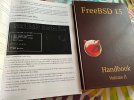
Thank you!

I had the FreeBSD 15 handbook printed from lulu.com. To the people that have worked on this very useful and valuable operation system, the documentation writers, the people answering questions in the FreeBSD forums and the wallpaper designers, thank you all.
 

Attachments

  • IMG_7252.jpeg
    IMG_7252.jpeg
    922.2 KB · Views: 122
Now that I've seen it, I absolutely want the same one. 🙄

Is it possible to get more information, such as price, delivery time, and print quality?
Yes, it is 67,5 euro for both parts. The delivery time was approximately 50 days. Print quality is standard, hardcover
Now that I've seen it, I absolutely want the same one. 🙄
e
Is it possible to get more information, such as price, delivery time, and print quality?
Also options: printbook, split pdf in 2 books, paper #80 white coated, bended type cardcover case wrap, matte cover finish.
 
I had the FreeBSD 15 handbook printed from lulu.com. […]
I believe you were disappointed when you realized the pages are all wrong: the left‑hand page is printed on the right and vice versa (see page numbers which are usually located at the outside margin). I mean, yes, the book “works” regardless.​
Now that I've seen it, I absolutely want the same one.
Please don’t print the PDF. Great, “Single‐User Mode” and “Stage Three” are printed in blue, but it doesn’t specify which page. Both are in chapter 15 (so ≥ + 284 pages, not anywhere in the vicinity). This is of course not an issue when viewing the PDF on a computer. ⟨insert image of person holding opened handbook hardcopy while sitting on laptop keyboard⟩

Also it is terribly typeset, e. g. magazine margins for a book, no use of ligatures, justified composition without hyphenation, numerous orphans and widows, rivers, footnotes not appearing on the same page (but at end of chapter), and so on, which – don’t get me wrong – I don’t mind too much when viewing on a computer screen.

Previous testimonial: Thread 92208
 
Thanks Kai Burghardt for the advice, I don't have your typography knowledge but what you're pointing out seems plausible. Actually, I was thinking of using a local printing company; maybe they have tools to fix these problems ?

I love books and I absolutely hate reading on a screen; it's very good for a technical consultation on a specific point, but unpleasant for reading.

PS : I quickly scroll the handbook in PDF format and there are page breaks for a single word; this PDF is not meant to be printed :-(
 
[…] Actually, I was thinking of using a local printing company; maybe they have tools to fix these problems ?
Forget it, it’ll cost a fortune. Moreover, given that all kind of crap (referring to typographic quality) gets printed, I would even doubt you’ll successfully find a good typesetter.​
Code:
Producer:       Asciidoctor PDF 2.3.19, based on Prawn 2.4.0
Unfortunately, it is really painful to produce (typographically) decent PDFs with *LaTeX, too, so .adoc.tex.pdf isn’t much of an option either. In‌Design or print/scribus can do lots of (but not all) things, yet at 1 kilopages the visual workflow becomes unsuitable. You do this once for a static work (e. g. Qurʾan).​
I love books and I absolutely hate reading on a screen; […] but unpleasant for reading.
Have you tried “electronic paper” screens? Maybe it’s less of a strain on your eyes. (Unless you are specifically going for the physical paper haptics.)​
PS : I quickly scroll the handbook in PDF format and there are page breaks for a single word; this PDF is not meant to be printed :-(
To make things more difficult, it is a sin to hyphenate across pages (so you have to turn the page to finish reading one word), a blunder I see too often nowadays.​
 
Maybe the handbook can be downloaded as (La)TeX? That would solve a lot of these problems.
 
Maybe the handbook can be downloaded as (La)TeX? That would solve a lot of these problems.
Indeed it would, but at least on the website, download option seems to be limited to PDF. There is an option to view as "Single HTML" which may work/be easier to conver to TeX-ish?
I've had printed copies of the years usually from Walnut Creek and other vendors, so logically there must be a framework for it.
 
I would imagine that there is a TeX source that gets build into a PDF and HTML, and maybe it simply needs to be compiled for a book style and offered for download as well. But that's me.
Maybe one of the unsung heros of the team (the doc gals/guys) can pipe up here for some more information.
 
I love books and I absolutely hate reading on a screen; it's very good for a technical consultation on a specific point, but unpleasant for reading.
Have you considered using an e-ink tablet? Far from perfect but a lot less eye strain. Plus you can zoom in / out (which will matter for people above a certain age!) + you don't have to carry hefty books.
 
Being a fervent document writer myself I wholeheartedly agree: FreeBSD's documentation (and its quality!) is nearly unmatched.

No offense intended (!), but if you compare the FreeBSD documentation with the stuff that Linux provides then... :rolleyes:

I mean, /usr/src has a solid README with good references to the handbook, and in extend also the architectures handbook. Now compare all that to... the doc folder within the Linux kernel sourcetree? In all honesty (!) things became better over time, but it is painfully obvious that good documentation has always been an afterthought there.
 
Kai Burghardt and bakul : I have never tried electronic ink, I see beautiful screens and as you suggested, I will certainly try it.

Maturin globally I don't agree with you, the point is not to get a local copy of FreeBSD documentation; I have forked the read-only mirror freebsd/freebsd-doc and I keep a up to date local copy. Why did I spend money to buy "The design and implementation of FreeBSD operating system" instead of getting it for free on the web ?

It's the same here; it's about having a beautiful book on a fascinating subject. Don't get me wrong, the final goal is only to read stuff about FreeBSD.

And anyway, since I'm just a donkey, I've already started working with asciidoctor from the .adoc files to generate a printable pdf; it's better, but not yet sufficient. I know I'll have to do a lot of proofreading, and it probably won't help in the end. Unless I end up to mind all the documentation 🙄
 
"The design and implementation of FreeBSD operating system" instead of getting it for free on the web ?
Of course you disagree. I'd also disagree with that.
But that was not my point.

You are comparing apples with pears.
You are comparing a user's short reference manual with a scientific book about systems and principles in general.
You are comparing free electronic books with electronic black copies of hardcopy books.
AFAIK a current up-to-date edition of "The Design and Implementation of FreeBSD Operating System" is legally only available to buy as a hardcopy.
Some of such books sometimes become available electronically for free, when they are outdated and obsolete, and the new edition is published (as a hardcopy to buy.)

The point of my post was:
Apart from doing it as a learning lesson how to do such a thing at all,
I don't see no real sense in trying to self create a local copy of a book which already is available as a local copy (by a pkg install), or turning an online HTML version of a book into a PDF by yourself, while the package also already delivers the PDF version.
And above all I don't see much sense in printing an user's short reference manual on paper about an OS, that provides a new version every three months.
Imagine you had a hardcopy of the FreeBSD HB in your shelf you printed yourself two and half years ago.
What would the title say?
"FreeBSD 13.2", that's right.
If you would see that book in my shelf you probably would say to me something like, 'Dude, you are such a caveman. That book is so outdated, so obsolete! We are at 15.0 by now, 15.1 coming soon!'
<[begin assisted thinking]>
Now, how do you think will look the hardcopy of the FreeBSD HB you print today in two or three years in your bookshelf?
Would you rather say,
'WOW, cool! FreeBSD 15.0! Great!'
or would you more tend to say,
'Dude, we already are at 18.2!'
<[end assisted thinking]>

As I said, I also made this mistake myself several times, many years ago. For my excuse I can say it was still in times when - comparing to today - we had very slow internet connections.
<[begin war story]>
Back then I had the Motorola 28.8 modem. The 28.8 stands for 28.8 kBaud. That's 28,800 bit [sic!] per second [3.6 KibiByte/second], which was the top possible speed you may got when using the telephone landline (wired, copper) to dial into a computer to get internet access by home at all those days. You may compute a MB used almost 5 minutes to download - if the line was clean and not interrupted, e.g. by somebody tried to give you a phone call, e.g. mother again asking with whom I always had those endless telephone calls blocking the line, simply not grapsing the internet. So, you can imagine files with several MB (e.g. handbooks, or even installation disc images) was nothing you just downloaded spontaneously en passant, but planned a bit when do it best, e.g. during the night, when the telefon rates are low and I don't use the computer (At least I wasn't the typical white faced nerd, sleeping the day and sitting all night long at the computer.)
<[end war story]>
So it was a very good idea to have a local copy of such books.
Plus monitors had not the quality, above all not the high resolution they provide today, and computers needed one or two seconds to load a larger file (plus maybe swapping while turning the pages.) So reading a PS/DVI/PDF online in a viewer was not that comfortable as it is today.
But already back then it was stupid to print them all out completely, which I did.
I had several lever arch files containing several handbooks. All wasted paper. Because the frequency I consult those hardcopies didn't match the frequency the according software was updated.
I produced way more scribbling paper I had use for, many, many thousands sheets of paper, plus ink cartridges all for the garbage.
And to warn you to not do the same mistake as me, that was my point.

Neither the FreeBSD foundation, nor the developers, not even the community has any benefit by that. Only the market sells you your next printer, the printer's manufactures, the producers of paper and printing cartridges profit from that - and, as I tried to explain elaborated, not even yourself really.
So, you better do a donation to the foundation instead of wasting your money on producing waste paper and lower the life time of your printer, only.

So, to summerize the lesson (my point):
For sure there are books better have as hardcopies.
But user's short reference manuals are not part of those.

What I can understand is, when somebody found her/his way into FreeBSD and wants to give that proud kind of a small monument. I fully understand that, because I feel the same. But for that I do not print out the handbook, and place it into my shelf. For that I have among others "Absolute FreeBSD" in my book shelf - not only as a monument, but actually a really useful book, worth to have it as a hardocpy. And I have a high quality print of the FreeBSD logo at my wall.
The foundation's shop provides shower curtains, baby's dribble bibs and bathing slippers with the logo, but alas no stickers (at least the last time I checked.) Otherwise my laptop's lid also had a FreeBSD logo attached. :cool:
 
What I can understand is, when somebody found her/his way into FreeBSD and wants to give that proud kind of a small monument.
That's why I did this video :D (started 14.1 and excitedly got 14.2's installer from a link somewhere before Announcement)
View: https://www.youtube.com/watch?v=4MXV80q17ww

FreeBSD's also where I found out about Chicago95, and it makes a cool sleeper looking set-up (who'd suspect hidden power from a modern laptop looking like Win95 :p)
 
That's why I did this video
👍😂
Throwing all the money "into" Windows is just great.👍👍👍 😂

Idea to make it even better: After the Windows money throwing scene do a cut, and then show a natively installed FreeBSD, and what you do with that. That would make your point clearer, as I think, because at the moment the viewer does not really understands the point, because besides the small FreeBSD window (which is not grasped by Windows users) Windows still makes the main screen, so seems to be the host.
 
Back
Top