licenses and all that jazz

I will start with a history Im sure I listened somewhere, but cant find, probably I just dreamed of it, but it was something like

There was this guy that worked everyday for a company and it the night at home rewrote all in another language, them months later introduced an alternative to the company software but the code was his as there was no derivate work and was made on his time and own resources, so the demand lead no where.

I have asked some LLMs to find the source but none have found it :).

Anyway, going back to "derivate works" and GPL spread like a virus, I have seen comments like this https://github.com/microsoft/WSL/issues/178#issuecomment-249443216 about clean room implementations over GPL code like the linux kernel.

But I have always wonder, if I read any GPL code means all my code related to that are derivate works? like if I contribute to blender 3D I will not be able to contribute to private competition as I have seen the code of related work?


I mean from the "history" it seems that derivate work was flacky under a contract, but under GPL is still GPL?

I mean I have seen a lot of people said you can read some GPL code and then make your own that is why there is LGPL.

So my Qs are:

  • do you know that history? or I did smoke/dream something?
  • it is true that derivate work is anything you do after reading some other GPL code? I mean making tutorials GPL will make them unusable as you will not be able to do any future work that is not GPL at all.
  • also the source code does contain some GPL + bsd code... so that what means really, how you comply with GPL while also with bsd that allows you to keep it closed if you wanted?


Also just to add, I have seen some tools that promote input GPL code and with LLMs do a "clean room" reimplementation of the lib so you can "free yourself" from GPL.
 
No, you just have to be mindful not to copy. Most code is the way it is because it's solving the same problem and If you were to look at a bunch of codebases from private and public projects they'll be rather similar.

The area to be more concerned is if you're using processes and algorithms that originated from there and especially not reusing code with comments. You can do that, but such resulting code would need to comply with the GPL.
 
You do not need to worry about "clean room" with GPL.
As long as you do not copy the code (verbatim or with some mechanical transformation) you are free to read GPL code to pick up ideas, knowledge of hardware, etc.
Nobody will go after you. You are not "tainted".

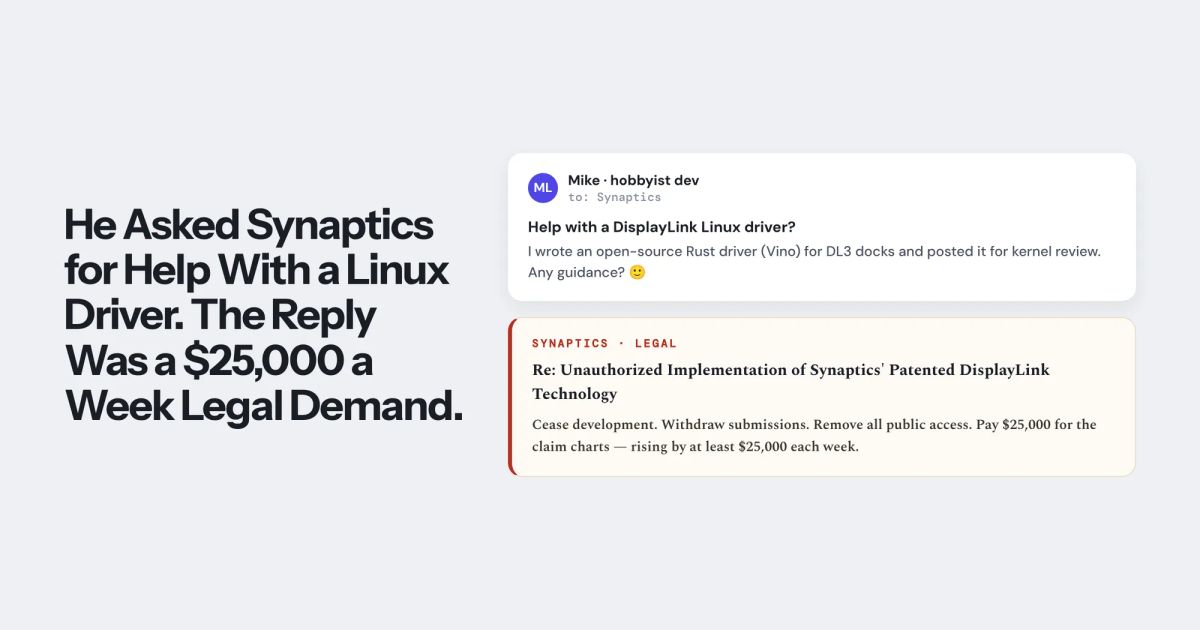
But watch out for patented code. Some of GPL code is patented and it's a very different dimension not exactly related to GPL.
 
So the question remains, it seeems plausible that any worker can duplicate work at night with its own resources and time and make a competitor of the product at hand?

By what Andriy says a GPL tutorial you can make derivates from what you learned from it?
 
So the question remains, it seeems plausible that any worker can duplicate work at night with its own resources and time and make a competitor of the product at hand?

By what Andriy says a GPL tutorial you can make derivates from what you learned from it?
In the end a judge might have the last word. I think this is all too far away from the real world. Really nobody is going to look at where you got your code from, unless it's actually competing and valuable above what commercial software already provides. But nobody is going to make something like that publicly available and waive any potential profit. What remains is mostly whining about not really existing inventive capabilities and implicated ownership that's never going to be more than just an opinion and bring any advantage. It's a waste of time.
 
How to know which is patented code?
Usually there would be some notice about that, but don't count on it.
One (in)famous case was/is RCU implementation in Linux:
I hear that RCU is patented? What is with that?

Yes, it is. There are several known patents related to RCU,search for the string "Patent" in Documentation/RCU/RTFP.txt to find them. Of these, one was allowed to lapse by the assignee, and the others have been contributed to the Linux kernel under GPL. Many (but not all) have long since expired. There are now also LGPL implementations of user-level RCU available (https://liburcu.org/).
 
I did read that, but it seemed that the only protected thing was the patents, that is why I said "interesting" as it seems patents are really the only thing that impedes source code to be derived even from a clean room implementation.

If you see, in the original post I have 3 questions

* have you ever listened that "history"
* does GPL derivations impede reimplementation (thus being stronger that you as a worker for a company can make a competitor in your time and resources for what you work on)
* how should people really handle GPL and similar licenses (v3, AGPL and more powerful if there is any), as I have posted before the first linux implementation of WSL was a clean room implementation with a zero tolerance for anyone looking at linux kernel (or so they said) but they have not released the specification ever (so any other team can do a clean room implementation of linux kernel), there is only the code. But according to other people you can look at GPL code and implement your own stuff... seems very weak point of view to hold in court... I mean you dont even need clean room if you take that point of view.

So not sure how that article answers any of the 3, at most it said that in court the only that stands protection are patents. So drhowarddrfine if you can make it more clear, will be useful.
 
By the way, I have already asked this question long a go at https://github.com/github/choosealicense.com/issues/1247 (still open after 2 years) but really no useful response or PR has been merged, seems no one on internet really knows about that stuff or can close the issue as "this dude is just paranoid"... and so the teams at microsfoft that implemented some GPL code in clean room... but this dude from history that no one has confirmed or rejected legally was able to do a competitor from what he clearly learned/knew from the code he was paid to do with a contract (so gpl seems more "powerful" than a contract for a developer).
 
Back
Top