

Im learning about managing the performance and efficiency cores in Intels later cpu-models.
the Arrowlake Ultra 9 285K cpu have 8 performance and 16 efficiency cores.
Performance cores are: 0, 1, 10-13, 22, 23 .
Efficiency cores are: 2-9 and 14-21 .
This dispersion of cores seems to be to manage heat and cooling of the cores.
Its possible to start the Xwindows KDE6/Plasma6 desktop with the standard .xinitrc and the command cpuset
$ cat .xinitrc
exec dbus-launch --exit-with-x11 ck-launch-session startplasma-x11.
$ cpuset -l 0,1,10-13,22,23 -s 1 startx
The when I start a browser :
ps -a | grep firefox
62415 v0 S 0:03.57 /usr/local/bin/firefox
63652 v0 I 0:00.05 /usr/local/lib/firefox/firefox -contentproc -initialChan
The browser executes in the performance cores.
cpuset -g -p 62415
pid 62415 mask: 0, 1, 10, 11, 12, 13, 22, 23
I can start a compilation run in the Efficiency cores:
# cd /usr/ports/editors/calligra
# cpuset -l 2-9,14-21 make install
this rumbles for a while creating this BTOP img:
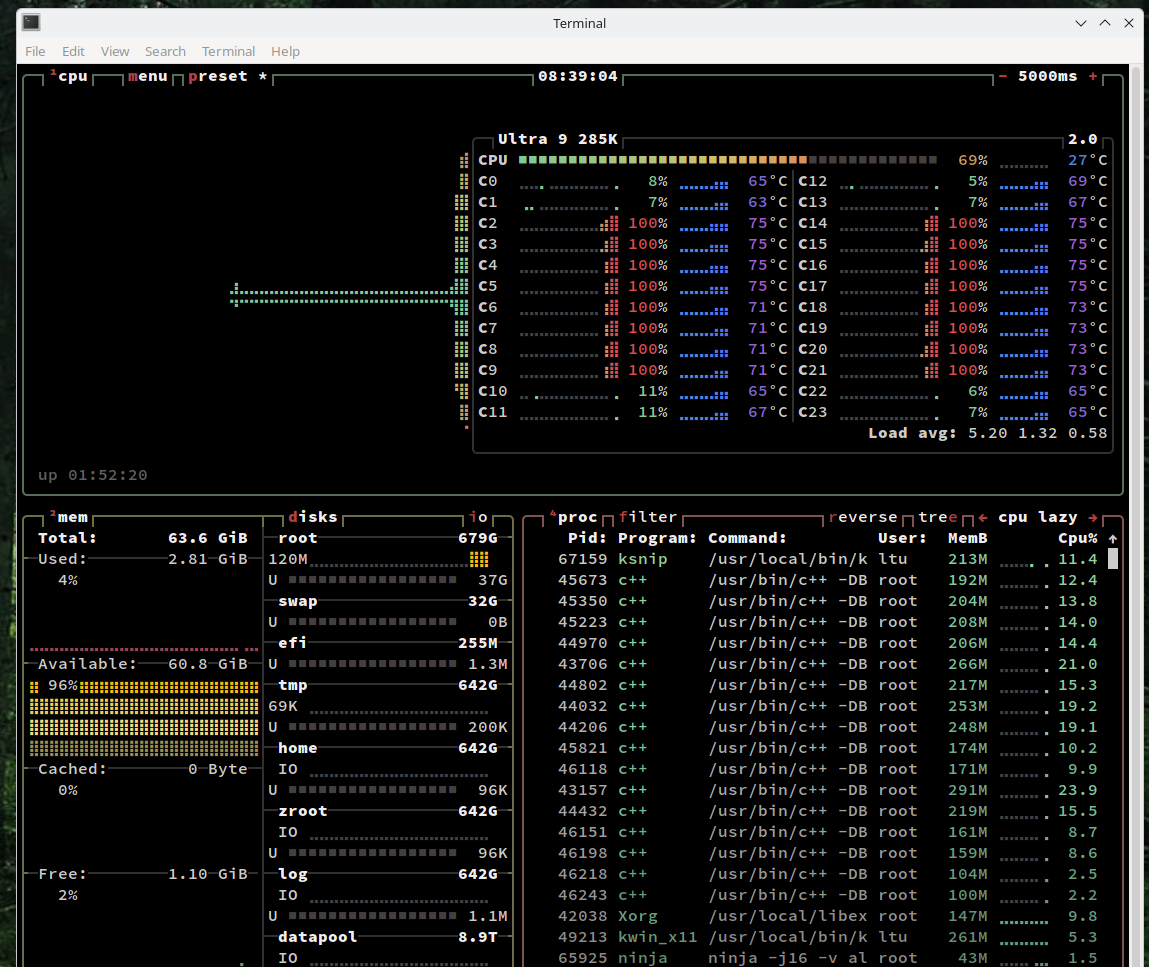
So it works and a specific task can be contained to a subset of cores.
NOW: the core allocation into CPUSETS seem to be very transient and require manual commands each time.
when the Xwindow sessione and sample compile run have completed and the user have logged out of the Xwindows session, the CPUSET's allocations have vanished.
- can the OS "remember" the CPUSETS somehow , so that they dont need to be cpuset befor every command ?
//Regards
the Arrowlake Ultra 9 285K cpu have 8 performance and 16 efficiency cores.
Performance cores are: 0, 1, 10-13, 22, 23 .
Efficiency cores are: 2-9 and 14-21 .
This dispersion of cores seems to be to manage heat and cooling of the cores.
Its possible to start the Xwindows KDE6/Plasma6 desktop with the standard .xinitrc and the command cpuset
$ cat .xinitrc
exec dbus-launch --exit-with-x11 ck-launch-session startplasma-x11.
$ cpuset -l 0,1,10-13,22,23 -s 1 startx
The when I start a browser :
ps -a | grep firefox
62415 v0 S 0:03.57 /usr/local/bin/firefox
63652 v0 I 0:00.05 /usr/local/lib/firefox/firefox -contentproc -initialChan
The browser executes in the performance cores.
cpuset -g -p 62415
pid 62415 mask: 0, 1, 10, 11, 12, 13, 22, 23
I can start a compilation run in the Efficiency cores:
# cd /usr/ports/editors/calligra
# cpuset -l 2-9,14-21 make install
this rumbles for a while creating this BTOP img:
So it works and a specific task can be contained to a subset of cores.
NOW: the core allocation into CPUSETS seem to be very transient and require manual commands each time.
when the Xwindow sessione and sample compile run have completed and the user have logged out of the Xwindows session, the CPUSET's allocations have vanished.
- can the OS "remember" the CPUSETS somehow , so that they dont need to be cpuset befor every command ?
//Regards


