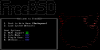
Computer reboots when loading install CD

Hello everyone,

I am attempting to install 10.2-RELEASE on an old AMD K6-II I have using a CD. When I try, I get:

Code:
CD Loader 1.2
Building the boot loader arguments
/
and then the computer reboots. I am using the i386 disc1 image and the MD5s checked out. I downloaded another copy and re-wrote it anyway but there was no difference. I successfully booted an old 4.2-RELEASE CD and a random Linux CD to rule out the optical drive, and they were fine (though I got nothing but reboots from FreeBSD 8.1 and 7.2 disks). I agree that this machine is downright ancient but it has historically run (and been well-supported) by many editions of FreeBSD and NetBSD in days of yore. It is currently running Debian Linux and appears to be otherwise alive and healthy.

I tried a few things in the BIOS such as change IDE types (LBA/AUTO/LARGE/NORMAL etc) with no difference. Disabling ACPI didn't help either. The handful of hits I got from the Google Machine found that most people with this problem were using the wrong image (amd64 instead of i386). One hit went unanswered. Booting from flash or PXE isn't an option for this machine and it appears that floppy install images have long fallen by the wayside. I understand that there isn't much to go on in the way of feedback from the failed boots, but I would appreciate any suggestions. If there is anything I could do to provide more info please let me know.

Here are the relevant specs for information and jeering:

Code:
CPU:  AMD K6-II 300Mhz
RAM: 256MB SDRAM 100mhz
Motherboard: Something like a PC Chips M571 or similar
HDD: WD Caviar 6.4GB (Set primary master)
Optical: Lite-On IDE DVD-RW (Set secondary master)
Fd0 Drive: Yes
Video: STB Nvidia Riva TNT (PCI, 16MB)
Sound: Onboard something something (Disabled)

Thanks in advance.
 
Hello phaeton. Have you tried setting the "safe mode" boot option?
FreeBSD-10-2_boot_options.png
(Click me)
 
Ah, okay. I didn't catch that you were never getting to the menu. Yeah, that is a tough one. I have no more ideas for you at this point. Maybe it is just time to retire that old hardware if you want to run FreeBSD 10+. I know, I know, I am a pack-rat too and love running old hardware with *n?x systems installed. Unfortunately everything eventually gets left behind with the newer operating systems / distributions. I finally had to retire an old 386 PC about 3 years ago that got left behind even though it still worked okay. ;)

In any case, if I come up with anything else you can try I will follow up.
 
Hi phaeton, welcome to the forums. I run a couple of similarly aged but adequate FreeBSD machines at home, one of them even creaking along with ZFS, so you won't hear any jeering from me. I imagine you are already running the most recently released BIOS for your motherboard but if not it would be worth updating and trying to boot from the CD again. For my old machines I was surprised that there had been a BIOS update long after most of the machines would have been retired that added support for USB booting so you never know.

Failing that, since neither a USB memory stick nor PXE boot are options for you, you could try plugging your hard disk into a different i386 or amd64 machine and installing FreeBSD onto the disk using that machine. Don't spend time configuring it; just set a root password. Then put the hard disk back into your original machine and try booting from the hard disk. If it works you can log in as root and run bsdconfig(8) to complete the same configuration you were offered during the installation.
 
Hi phaeton, welcome to the forums. I run a couple of similarly aged but adequate FreeBSD machines at home, one of them even creaking along with ZFS, so you won't hear any jeering from me. I imagine you are already running the most recently released BIOS for your motherboard but if not it would be worth updating and trying to boot from the CD again. For my old machines I was surprised that there had been a BIOS update long after most of the machines would have been retired that added support for USB booting so you never know.

I'm not sure if it's the latest or not. I updated the BIOS in 2000 or 2001, but there may be another update for it. Wouldn't you know that I just went through a bunch of old parts and manuals and I think I threw out the manual for this motherboard. It isn't marked anywhere so I'll have to look and see if there's a way to nail down exactly which model it is. The BIOS itself is a generic Award from the era and doesn't tell me much. If not, it may be that it'll never be a FreeBSD machine again. At least there are alternatives.

Failing that, since neither a USB memory stick nor PXE boot are options for you, you could try plugging your hard disk into a different i386 or amd64 machine and installing FreeBSD onto the disk using that machine. Don't spend time configuring it; just set a root password. Then put the hard disk back into your original machine and try booting from the hard disk. If it works you can log in as root and run bsdconfig(8) to complete the same configuration you were offered during the installation.

I thought of trying that, though I think it's more of a BIOS issue than a drive issue. The irony is that this machine was destined to be a PXE server for install images for other machines, mainly because I have a fleet of old iron with dying or dead optical drives.
 
I thought of trying that [plugging your hard disk into a different i386 or amd64 machine and installing FreeBSD onto the disk using that machine], though I think it's more of a BIOS issue than a drive issue.
It was to overcome the CD loader/BIOS issue that I suggested it, not because I think your CD drive is broken (you said your optical drive worked fine with GNU/Linux CDs and others). The CD bootloader is different code from the normal MBR bootloader, so if you can get around needing to boot from CD on that machine to install FreeBSD then the normal MBR bootloader may well work fine with your BIOS. Using another machine (with a different BIOS) to install to your hard disk and then moving the disk back into the problematic machine would be a way to try that. I hope that makes sense.
 
asteriskRoss said:
The CD bootloader is different code from the normal MBR bootloader, so if you can get around needing to boot from CD on that machine

Ah... That part (different bootloaders) didn't occur to me, thanks. Sorry I misinterpreted your reply previously. Meanwhile, I might have some time tomorrow to give that a shot.
 
I did successfully install FreeBSD with the hard drive in another computer (p4). Back in the K6-II all seems well. I've dug into the BIOS update quest a little and it was a rabbit hole- This motherboard was marketed under a dozen or so Taiwanese manufacturers and in a significant number of configurations (some of which are one-off model numbers). Adding that we're talking nearly 20 years ago, this may be a real journey.

In any event, if I ever need to reinstall I know how to do it, and/or I'll try Plop like wblock@ suggested. Also, I'm under no delusions that anything I do with this machine (or the handful of p4s in the same room) will be anything other than 'hobby level'. I just hate to throw out a good, working system when I know it can still do useful things.
 
I'm pleased you got your machine working, phaeton.

I'm under no delusions that anything I do with this machine (or the handful of p4s in the same room) will be anything other than 'hobby level'. I just hate to throw out a good, working system when I know it can still do useful things.
The computing power of older machines is comparable to today's embedded systems or hobby hardware like the Raspberry Pi, so I totally agree with you that there is no need to throw out working systems. Indeed, my systems at home are typically sourced from people doing exactly that. Would I deploy a 15 year old machine as a mission-critical server at work? Of course not. However, for many purposes it would not be the capability of the hardware that would prevent me but the reliability.
 
Back
Top