what to do with it?
That.Basically an oscilloscope allows you to monitor with probes a range of electrical values and view the output by time and range.
Or explained in another way:
An oscilloscope shows the change of voltage over time - to examine very fast voltage changes en detail.
Any other value, not only electrical, can also be measured. But it must be represented as a voltage, and the rate - how many V represent how many A, N, Pa,... - must be known, of course. Oscilloscopes can only measure voltage. So any other value must be transformed into voltage first.
In default mode the abscissa ("X-axis") represents the time (depending on the scale adjusted to tiny fractions of a second: ms, µs,...), while the ordinate ("Y-axis") shows the voltage in V, mV,... - it's adjustable (mostly auto today), and depends on the scope.
Is it a periodical signal - the changes repeat the same way all the time (sine wave, saw tooth, rectangle [PWM or binary transmissions up to some MHz] - scan and display are synchronized to the signal's frequency, so you can watch and measure closely within the signal as it was standing still.
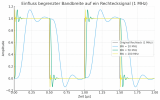
You can "zoom in and out", which means you change the time and voltage scale of the display. So you can take very close looks at details, e.g. the over- and under swinging behaviour directly after the falling flank (typical for a transistor switching at high speed.) In modern digital oscillosscopes you can move rulers in the display to measure the voltage difference between two level, or the time span between to incidents resp. the frequency.
When the scope has more than one channel you can see the signals of each probe at the same time and directly compare each other, e.g. to see the changes e.g. an amplifier or a filter does to the input signal. Or look at a digital bus. I picked that example randomly from the web; it seems to show 11110000000000011111100000000 sent on a 32bit 1.25 MHz serial bus:
You can also record a timespan of a signal, and then look at it. Depending on the scope long term measurements over hours, days, perhaps even longer are possible, but better use a so called logger for that.
Or some very fast single incident, like the voltage during a spark discharge:
Note the 0 µs. The scope's trigger waits for the voltage cross a preset limit, then records the voltage for a preset time window. In this example the 4 µs before and 6 µs after it was triggered.
Save screenshots and data to a file to an internal storage drive, USB flashdrive, sd card, or via LAN are also default features of modern scopes like saving that data as CVS and several other formats. What exactly depends on the scope, of course.
That's simplified the basics. Oscilloscopes are very comprehensive multi-measurement devices. Today's oscilloscopes are almost all digital, which means they are embedded computers, bringing a lot of analyzing software like FFT, network analyzers and (many) other things.
It has many purposes, like to see how much noise a signal has, if it contains tolerable peeks, etc. etc. - to see, if a circuit does it's job as intended to resp. clean enough, and if not, what may cause the problem.
An experienced electronics technician/engineer can trace back certain "patterns" to certain causes.
But unless you start on electronics yourself, you don't need to learn more.