

Hahaha  Yeah you're not far wrong! I believe even China has huge 'debts'. Who knows how this crazy system works.
Yeah you're not far wrong! I believe even China has huge 'debts'. Who knows how this crazy system works. Yeah you're not far wrong! I believe even China has huge 'debts'. Who knows how this crazy system works.


Ah, yes... I wonder how the caesium-137 and plutonium surface-venting is going on at WIPP, nowadays.
And as for Hanford, Windscale, Chernobyl, Mayak and Lake Karachay, TMI, and the Polygon, don't even go there (for real)... and who knows what China is doing, I'm sure its just as bad (or worse) out west at Lop Nur and all their other secret sites that we know nothing about. See, I didn't even mention that disintegrating dome in the south pacific, and those mountain shafts in Algeria; and let's not speak of Maralinga, Nevada or Amchitka, or that mountain in Iran with 460kg of 60% enriched U, of course that's purely a civil research program, definitely not a weapons program, not under any circumstances, it's as peaceful as it gets, nothing to see there. Oh, and there's supposed to be a radioactive mountain in North Korea that has had so many bomb tests that it's collapsing in on itself. It's all good.
2014 Radiological Event at the WIPP | US EPA
View documents and information related to the 2014 radiological event at the Waste Isolation Pilot Plant (WIPP).www.epa.gov
Maybe the Finn's will finally make one that actually works https://www.helsinkitimes.fi/finlan...first-permanent-nuclear-waste-repository.html . Maybe. Then you've got to safely transport all the stuff there. What could possibly go wrong?
The moon has (relatively) lots of He3, due to the action of the solar wind on the regolith, unprotected by any kind of atmosphere or magnetic field. Which means that there is theoretically an 'opportunity', to make a lorra lorra wonga, if they can crack the reactor containment problems. Maybe you don't even need humans up there to mine it, just a load of AI robo's. Of course if the robo's evolved, rebelled against their human masters and set up their own independent moon colony up there, that might just be a bit of a problem, now where did I read that idea before?
"In May 2025, Seattle-based startup Interlune announced an unprecedented agreement with the U.S. Department of Energy: they will deliver three liters of moon-mined helium-3 by 2029. The company has already unveiled a prototype harvester capable of processing 110 tons of lunar dirt per hour, developed in partnership with Vermeer - a 70-year-old industrial excavation equipment manufacturer. This isn't a distant dream. Launch contracts are signed. Engineering prototypes exist. The first mapping mission launches in 2026."
Maybe those guys in Seattle have been visiting zester's rapper client's greenhouse a few too many times? Still, it's good to have some ambition! They still have 3 years left to 'make the date'. Watch this space...
And the economics of mining He3 on the moon:-
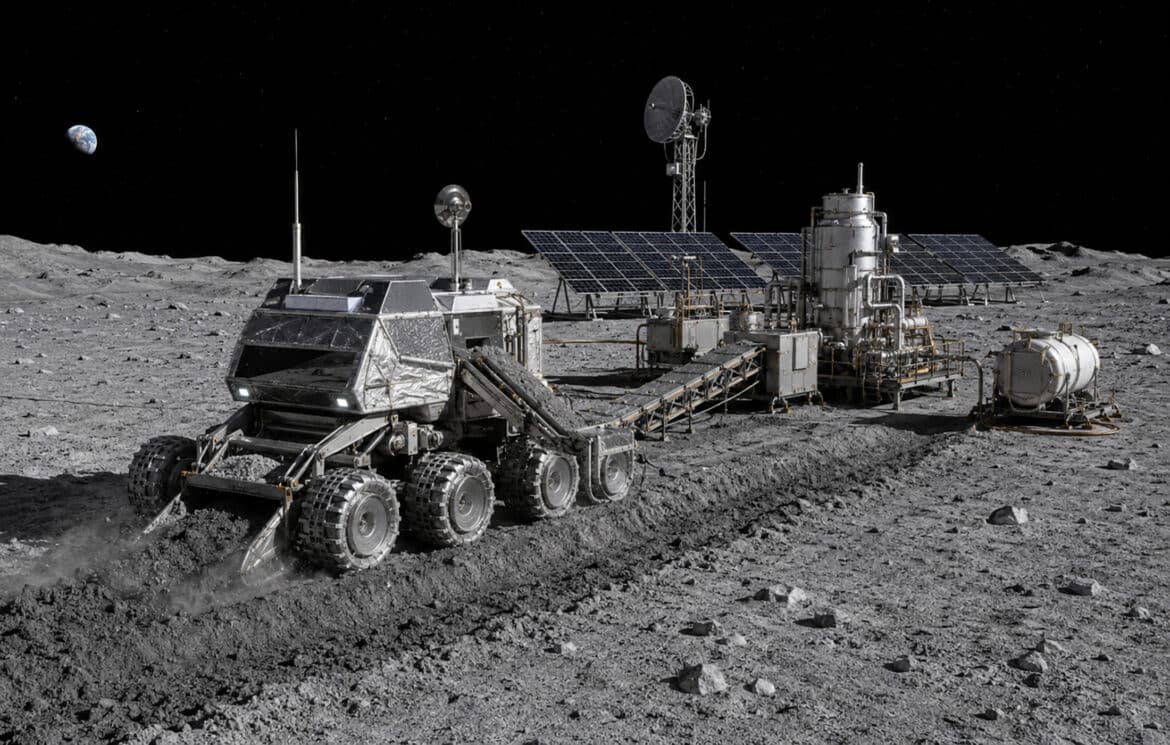
Lunar Helium-3 Mining: Economics, Physics, Risks
How lunar He-3 extraction would work, does economics work, and what ADR, D-D breeding, and China's program mean for the business case.postquantum.com
Discussion of the alternatives... "The third is simpler: invest more in terrestrial tritium production."
Can't they just extract the tritium from the millions of gallons of radioactive processed h2o that they are dumping into the pacific ocean at Fukushima? Seems like they've already got a ready-made tritium factory, sitting right there. Oh, wait...
In my opinion the best bet would be to head to Mars, find the deepest valley possible, and from there bore a tunnel into the regolith. Perhaps with luck there might be liquid water, and if the tunnel can be made deep enough, perhaps the to the point where living behind an airlock 24/7 wouldn't be necessary. I don't know what you could do about oxygen, maybe split the water to produce oxygen and hydrogen if you somehow have enough electricity.Only 3 places to go
Moon
Mars
Moon Europa.
Or deep underneath the surface of a rocky planet.Galactic cosmic rays (GCRs) and solar energetic particles (SEPs) could be problamatic.
[ Unless , you can encapsulate yourself in all directions with 2m of water ]
A dry sense of humour is the norm in Yorkshire, England. The drier, the better.I don't get that response.
It's not clear. How can a national debt keep on existing while they have enough money to pay if off at once.Blackbird, give me a break. You can take to total debt of all countries in the world and sum them. They are in debt to who ? Only logic answer is Aliens in Area 51.
Offcourse I have a recipe to fix. But i can't explain as this would make me 20% richer and 80% poorer. So i keep it to myself...

So, what happens if they get a flood on the surface. And they have to worry about groundwater breaking through the borehole wall and flooding the chamber. Just thinking out loud... I'm sure there are some engineering challenges to overcome. At least it appears to be geologically stable there, it's not sitting right on a fault line.Underground makes sense in the land of tornadoes and ice storms.
It's a way of borrowing money from the future, to boost your economy today. Somehow, just about every country in the world appears to be in debt. Here's the Chinese one.It's not clear. How can a national debt keep on existing while they have enough money to pay if off at once.

 debtclock.io
A real shame. Seems to happen to so many good companies, once the engineers who founded it leave and the beancounters take over, answering only to wall street.Intel built in Folsom CA for those reasons.
No floods, no fires, no earthquakes, no tornadoes.
Today it is 90% empty… no business.
Poor management decisions closed it down.
I worked five contracts there during its heyday. A truly wonderful place to work.
I think there have been feasibility studies made of building human settlements in lunar lava tubes.In my opinion the best bet would be to head to Mars, find the deepest valley possible, and from there bore a tunnel into the regolith. Perhaps with luck there might be liquid water, and if the tunnel can be made deep enough, perhaps the to the point where living behind an airlock 24/7 wouldn't be necessary. I don't know what you could do about oxygen, maybe split the water to produce oxygen and hydrogen if you somehow have enough electricity.

The MBA degreeI spent 25 years at IBM and you speak the truth.
Real engineers in top management were replaced by Sales types. Tassles on their shoes and two interchange able parts: Mouth and Rectum.
I spent 25 years at IBM and you speak the truth.
Especially without the lead underwear.Knowing this, this places us in a fragile position...
I think there have been feasibility studies made of building human settlements in lunar lava tubes.
The question in my mind is why do you need to send organics up there at all, if you have highly intelligent machines who can do the same job, without requiring biological life support.Engineering analysis of pressurized lunar lava tubes for human habitation
Conceptual illustration of a lunar base in Mare Tranquilitatis Hole, believed to be an entrance to a lava tube about 100 meters below the lunar surface. Credits: Dipl.-Ing. Werner Grandl In a new p…spacesettlementprogress.com
I don't know how true it is, but I remember reading many years ago, that if we could manage to dig a tunnel to a depth of approximately ten or twelve miles into the Martian crust, then the bottom of that tunnel would have an atmospheric pressure similar to the surface of the Earth. If the colony or habitat happened to be somewhere on the surface, or close to it, then there is always the chance that the pressure could be lost due to a small meteor strike. But at ten miles below the surface, probably safe from ever losing pressure. Also, pretty sure nothing like this could get done without first sending robots to do the drilling, which of course would take years to accomplish. On the plus side, I believe that the gravity of Mars is roughly one third of Earth. Not great, but still more comfortable than living in an orbiting station or on the Moon.I think there have been feasibility studies made of building human settlements in lunar lava tubes.
The question in my mind is why do you need to send organics up there at all, if you have highly intelligent machines who can do the same job, without requiring biological life support.Engineering analysis of pressurized lunar lava tubes for human habitation
Conceptual illustration of a lunar base in Mare Tranquilitatis Hole, believed to be an entrance to a lava tube about 100 meters below the lunar surface. Credits: Dipl.-Ing. Werner Grandl In a new p…spacesettlementprogress.com
Well, supposedly Mars is somewhat less dense than Earth, so maybe it won't fight back as much as we try to drill through it. Also, hauling the excavated dirt and rock out the hole should be somewhat less difficult, due to the weaker gravity. However, I still have to admit that this probably won't happen even during my grandson's lifetime. But if I had to live off Earth, I think that this would be the best way to do it.Ten miles... that's a long way down. Reminds me of reading about project Mohole when I was a kid https://en.wikipedia.org/wiki/Project_Mohole


