Greetings all,
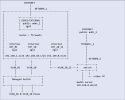
I am trying to separate my network (Network_1) form a network that I have been sharing with my landlord (Network_2), see the attached drawing. At this stage, the router/firewall/managed switch is working. I would like to share (at least temporarily) the media server that is on the Network_2.
When I try to mount the share on the media server, I see the first (SYN) packet of the 3-way TCP handshake reach the media server, but the response (SYN-ACK) packet does not arrive. My hypothesis is, that the media server does not know where to respond, so it sends the SYN-ACK packet to the default (192.168.0.1) gateway, instead to the (192.168.0.6) gateway from which the SYN packet arrived.
Is this correct? Is there any way I can change the configuration to complete the 3-way TCP handshake, thus mount the media server?
Kindest regards,
M
I am trying to separate my network (Network_1) form a network that I have been sharing with my landlord (Network_2), see the attached drawing. At this stage, the router/firewall/managed switch is working. I would like to share (at least temporarily) the media server that is on the Network_2.
When I try to mount the share on the media server, I see the first (SYN) packet of the 3-way TCP handshake reach the media server, but the response (SYN-ACK) packet does not arrive. My hypothesis is, that the media server does not know where to respond, so it sends the SYN-ACK packet to the default (192.168.0.1) gateway, instead to the (192.168.0.6) gateway from which the SYN packet arrived.
Is this correct? Is there any way I can change the configuration to complete the 3-way TCP handshake, thus mount the media server?
Kindest regards,
M